
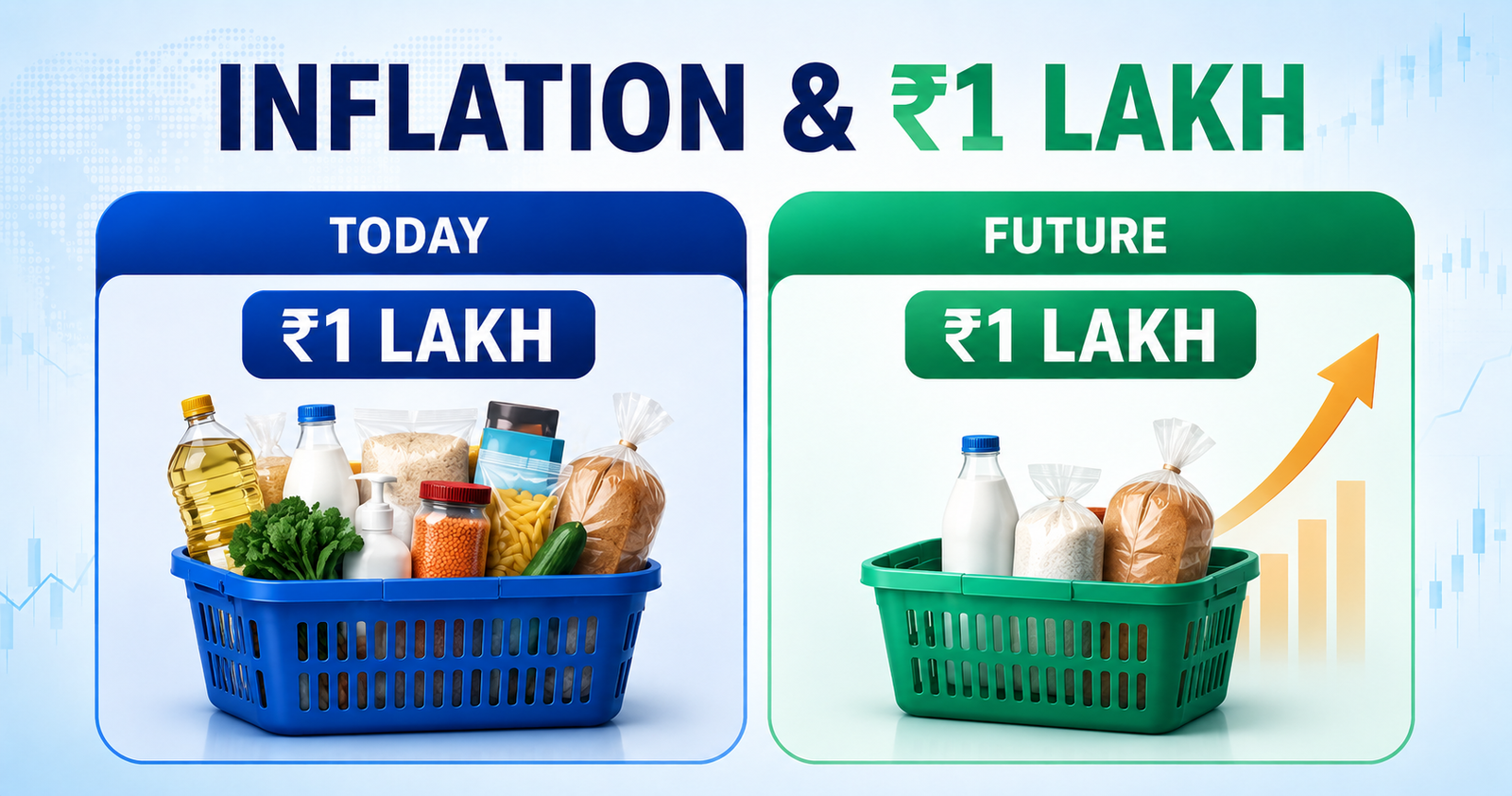
Inflation is easier to understand when we stop thinking about percentages and start thinking about purchasing power.
Suppose you have ₹1 lakh today.
Twenty or thirty years from now, you may still have ₹1 lakh in your account.
But it will not buy what ₹1 lakh buys today.
That is the real impact of inflation.
A Look at Long-Term Inflation
One useful historical reference in India is the Cost Inflation Index (CII).
CII is primarily a tax index and is not a measure of household inflation. But over long periods, it still gives us a useful indication of how the value of money changes.
Historical CII data shows that prices have multiplied many times over several decades. Freefincal recently illustrated this by showing that something costing ₹1,000 in 1981 would cost more than ₹16,000 on the same CII scale today.
Another way to think about the same thing is:
Money slowly loses purchasing power.
And your personal inflation may actually be higher than CII suggests, particularly when expenses such as healthcare, education and new lifestyle costs are considered.
A Simpler Rule for Financial Planning
Rather than trying to predict whether long-term inflation will be exactly 5.8%, 6.3% or 7.1%, we prefer a simple planning rule:
Assume your expenses roughly double every 10 years.
That works out to an annual increase of approximately 7.2%.
So if your monthly lifestyle costs:
| Today | Around 10 years later | Around 20 years later |
|---|---|---|
| ₹50,000 | ₹1 lakh | ₹2 lakh |
| ₹1 lakh | ₹2 lakh | ₹4 lakh |
| ₹2 lakh | ₹4 lakh | ₹8 lakh |
These are not predictions.
They are planning estimates.
Why This Matters for Retirement
Suppose you retire today and need ₹1 lakh every month.
Looking only at today’s expense can make a retirement corpus appear very large.
But if retirement lasts another 30 years, your expenses may be several times higher toward the later years.
The key question is therefore not:
How much money do I have today?
It is:
Will my money retain enough purchasing power to support my lifestyle for the rest of my life?
That is why simply keeping money “safe” is not always enough.
Your long-term investments also need to help protect you against inflation.
The Takeaway
You do not need to predict inflation perfectly.
For long-term financial planning, remember one simple rule:
₹1 today may need to become roughly ₹2 in 10 years just to buy the same lifestyle.
Or even more simply:
Expenses can roughly double every decade.
Use that as a starting point, review your actual expenses periodically, and adjust your financial plan as life changes.
This article is for educational purposes only. CII is a tax-related index and should not be treated as a direct measure of household inflation. Actual inflation experienced by each household will vary.