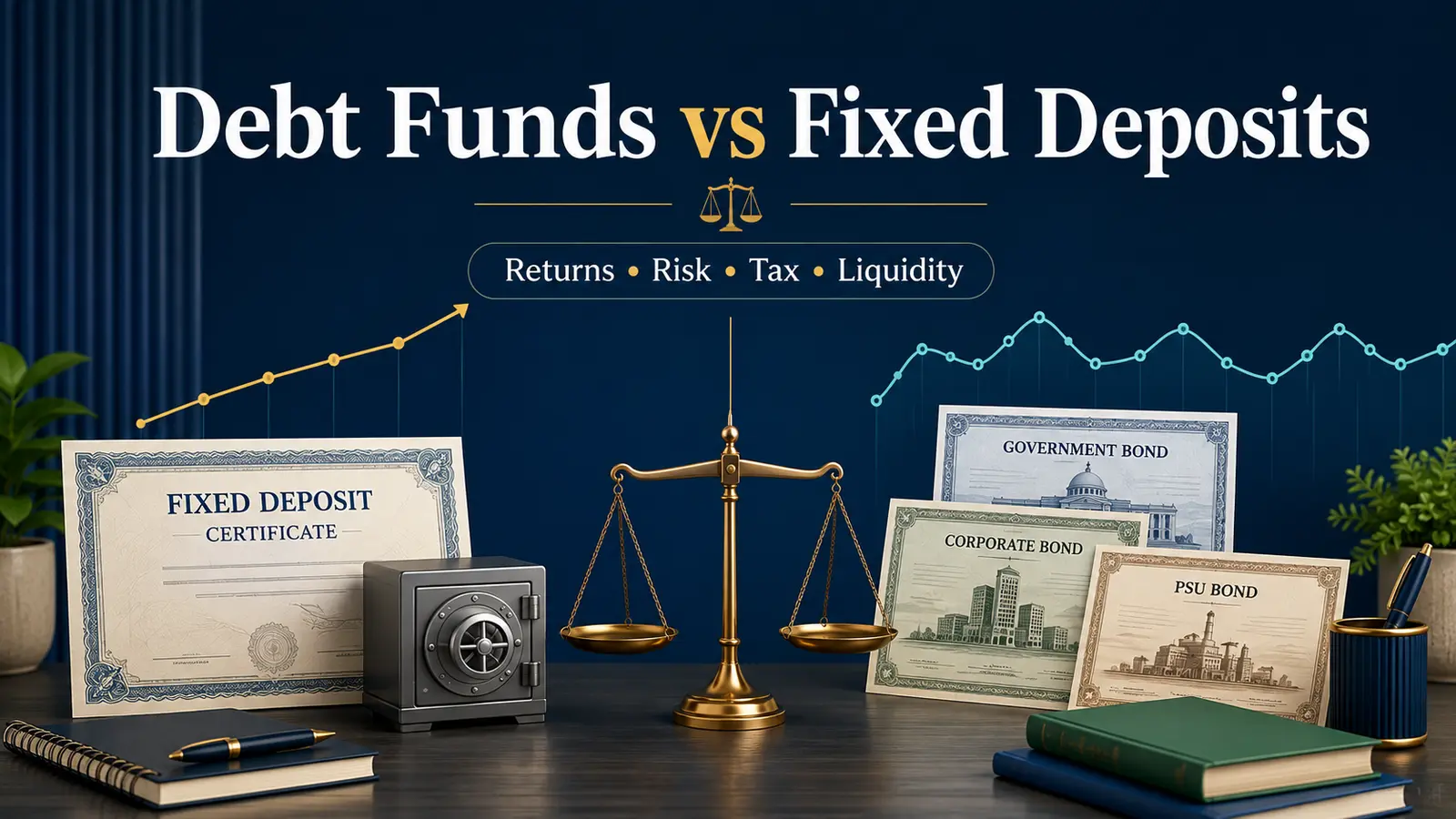
When you want to invest money without taking equity-market risk, two
choices frequently come up: a bank fixed deposit and a debt mutual
fund.
Both invest in the world of interest-bearing instruments, but they do
not work in the same way.
With a fixed deposit, the bank states the interest rate when you
invest. If you hold the deposit until maturity, you know broadly how
much you will receive. A debt mutual fund, however, invests in
instruments such as government securities, treasury bills, certificates
of deposit and corporate bonds. Its value changes with the market, so
its return is not fixed in advance.
This does not make one universally better than the other. The
suitable choice depends on what you need from the money: certainty,
liquidity, flexibility, capital stability or the possibility of
benefiting from movements in bond prices.
First, understand
what you are investing in
What is a fixed deposit?
A fixed deposit is money placed with a bank for an agreed period at a
stated interest rate. The rate normally remains fixed for that deposit
even if market rates subsequently change.
At maturity, you receive the principal and interest according to the
deposit terms. Some FDs pay interest periodically, while cumulative FDs
add the interest and pay the accumulated amount at maturity.
The important point is return certainty. Subject to
the bank meeting its obligation and the terms of the deposit, the
maturity value can be calculated when you invest.
What is a debt mutual fund?
A debt mutual fund pools investors’ money and invests it in debt and
money-market securities. Different categories take different levels of
maturity, credit and liquidity risk.
For example:
- Overnight funds invest in securities maturing in one day.
- Liquid funds invest in instruments with maturities of up to 91
days.
- Money-market, low-duration and short-duration funds take
progressively different maturity exposures.
- Corporate-bond funds concentrate on highly rated corporate
debt.
- Gilt funds invest mainly in government securities but can still
fluctuate because of interest-rate movements.
- Credit-risk funds deliberately take greater exposure to lower-rated
corporate bonds.
Therefore, asking whether “a debt fund” is better than an FD is
incomplete. A short-maturity, high-credit-quality fund is very different
from a long-duration or credit-risk fund.
Debt fund vs FD: the
comparison at a glance
| Return |
Stated when the FD is opened |
Market-linked; not guaranteed |
| Value during the holding period |
Usually not shown as fluctuating |
NAV changes on every business day |
| Maturity |
Fixed maturity date |
Open-ended schemes generally have no fixed maturity for the
investor |
| Early access |
Usually possible, subject to the bank’s terms and possible
penalty |
Units can generally be redeemed on business days, subject to exit
load and settlement time |
| Main risks |
Bank/default risk, reinvestment risk and inflation risk |
Interest-rate, credit, liquidity and reinvestment risk |
| Diversification |
Exposure to the deposit-taking bank |
Portfolio may hold securities from several issuers |
| Cost |
No separately displayed expense ratio |
Expense ratio is deducted within the scheme’s NAV |
| Tax timing |
Interest is generally taxable as it accrues or is credited |
Capital gain generally arises when units are redeemed or
transferred |
| Deposit insurance |
Eligible bank deposits are covered within DICGC limits |
No DICGC deposit insurance and no capital guarantee |
1. Certainty of return
The strongest reason to select an FD is that the interest rate is
stated upfront. If you know that a payment is due on a particular date
and cannot accept a lower maturity amount, that certainty can be
valuable.
A debt fund does not promise a fixed return. Its portfolio earns
interest, but the market value of its securities can rise or fall before
they mature. The fund’s expenses and any credit event also affect the
investor’s return.
You may see a debt fund’s yield to maturity, or YTM, on a factsheet.
YTM is useful for understanding the portfolio, but it is not a
guaranteed investor return. The portfolio changes, expenses are
deducted, securities may be sold before maturity and credit conditions
can change.
2. Safety and the
meaning of “guaranteed”
Investors often describe all bank FDs as completely risk-free. A more
precise view is necessary.
Eligible deposits with an insured bank receive DICGC protection of up
to ₹5 lakh per depositor per bank, combining principal
and interest and aggregating accounts held in the same right and
capacity across that bank’s branches. Amounts beyond this limit are not
protected by DICGC merely because they are in an FD.
Debt mutual funds do not receive DICGC protection. Their assets are
held in a diversified portfolio under the mutual-fund structure, but the
NAV can decline. Even a gilt fund, which avoids corporate credit risk to
the extent that it holds government securities, can experience
meaningful price movement when interest rates change.
So “safe” can mean different things:
- Certainty of maturity value: An FD is usually
stronger.
- Diversification across issuers: A debt fund may
provide it, depending on the portfolio.
- Protection from NAV fluctuations: An FD does not
display daily market movements in the way a debt fund does.
- Deposit-insurance protection: Available only for
eligible bank deposits and only within the applicable limit.
3. Interest-rate risk in
debt funds
Bond prices and interest rates generally move in opposite directions.
When market interest rates rise, existing bonds carrying lower rates
become less attractive and their prices may fall. When rates decline,
prices of existing higher-coupon bonds may rise.
The effect is usually greater for longer-maturity securities. This is
why a long-duration or gilt fund can show short-term losses even though
it invests in bonds rather than shares.
An FD handles the same rate movement differently. Your existing
deposit continues at its contracted rate, but a change in market rates
affects your opportunity:
- If rates rise after you create the FD, your money remains locked at
the older, lower rate unless you close and reinvest it.
- If rates fall, the locked-in higher rate benefits you until
maturity.
- When the FD matures, reinvestment may happen at a lower rate.
The FD therefore reduces visible price volatility, but it does not
eliminate interest-rate or reinvestment decisions.
4. Credit risk
is not the same across debt funds
Credit risk is the possibility that a bond issuer may delay or fail
to pay interest or principal, or that a downgrade reduces the bond’s
market value.
This risk varies widely. A portfolio concentrated in government
securities does not have the same credit profile as one seeking higher
yields through lower-rated corporate bonds. Do not select a debt fund
solely because its recent return is higher than its peers or current FD
rates. The additional return may be accompanied by additional duration
or credit risk.
Before investing, review:
- The scheme category and investment objective
- Portfolio credit quality
- Average maturity and Macaulay duration
- Concentration in individual issuers or groups
- The Riskometer and Potential Risk Class matrix
- Exit load and expense ratio
5.
Liquidity: access is available, but the cost differs
Most retail bank FDs permit premature closure, but the bank may
recalculate interest using the rate applicable to the actual period
completed and may also apply a penalty according to its disclosed
policy. Therefore, you may receive less interest than the original FD
certificate appeared to promise.
Open-ended debt funds can generally be redeemed on business days.
Some schemes impose an exit load for redemptions within a specified
period, and the proceeds are received according to the applicable
settlement timeline. The redemption value depends on that day’s
applicable NAV; it is not a predetermined amount.
Debt funds can also allow partial redemption without closing the
entire investment. With an FD, partial access may require closing the
deposit unless you created several smaller deposits or the bank offers a
sweep facility.
For planned liquidity, an FD ladder—several deposits maturing at
different times—can reduce the need to break one large deposit.
Similarly, a debt-fund choice should match the period for which the
money can remain invested.
6. Taxation:
the difference is often about timing
Tax rules are important, but taxation alone should not decide the
investment.
Fixed-deposit taxation
FD interest is generally added to the investor’s taxable income and
taxed at the applicable slab rate. This can apply even to a cumulative
FD where the interest is not paid out as monthly cash. A bank may deduct
TDS when the applicable conditions and thresholds are met.
TDS is only tax collected in advance. It is not necessarily the
investor’s final tax liability. The final amount depends on total
taxable income, the applicable regime, deductions and available
relief.
Debt-mutual-fund taxation
Under the rules applicable from financial year 2025–26, a mutual fund
investing more than 65% of its proceeds in debt and money-market
instruments—and qualifying funds of funds—is generally treated as a
“specified mutual fund” under Section 50AA.
For qualifying units acquired on or after 1 April
2023, gains on redemption or transfer are generally deemed
short-term capital gains and taxed at the investor’s applicable slab
rate, irrespective of the holding period. In the Growth option, tax on
the capital gain ordinarily arises when units are redeemed rather than
on the fund’s internal accrual every year.
This can create a tax-deferral difference, but it
does not automatically provide a lower tax rate. If you redeem only part
of an investment, tax generally applies to the gain contained in the
redeemed units—not to the entire redemption amount.
Units purchased before 1 April 2023, non-resident investors,
inherited holdings and schemes that do not fall within the current
“specified mutual fund” definition may require different treatment.
Consult a qualified tax professional for your specific holding.
A simple tax illustration
Suppose ₹5 lakh produces ₹40,000 of return during a year.
- With an FD, the ₹40,000 interest is generally taxable for that year,
even if it remains in a cumulative deposit.
- With the Growth option of a qualifying debt fund, an increase in NAV
is not normally taxed merely because the value rose. Tax generally
arises when units are redeemed, and only the realised gain is
considered.
This illustration explains timing only. It does not assume that both
products will produce the same return, and it ignores TDS, losses,
expenses and individual tax circumstances.
When an FD may be more
suitable
An FD may fit better when:
- You need a known maturity amount on a known date.
- You cannot accept even a temporary fall in value.
- The goal is close and capital certainty matters more than return
flexibility.
- You want a simple product that does not require monitoring duration
or portfolio quality.
- Your deposits remain comfortably within the applicable insurance
limits, or you have assessed the bank exposure separately.
Examples may include part of an emergency reserve, an upcoming fee or
down payment, and money required by a risk-averse investor on a fixed
date.
When a debt fund may be
more suitable
A carefully selected debt fund may fit better when:
- You need the ability to redeem only part of the investment.
- Your investment period matches the fund’s portfolio duration.
- You understand and can accept some NAV movement.
- You want diversification across debt issuers rather than exposure to
one bank.
- Tax deferral until redemption is useful in your situation.
- You need to manage money across several short- or medium-term goals
with flexible withdrawal dates.
This does not mean choosing the debt fund with the highest historical
return. The scheme category and risk profile must match the goal.
Can you use both?
Yes. The decision need not be all-or-nothing.
For example, a family might keep immediately required money in a
savings account, place the next layer in staggered FDs and use an
appropriately selected high-quality, short-maturity debt fund for
another portion with a less rigid withdrawal date.
The correct mix depends on the size of the reserve, income stability,
tax position, access requirements and comfort with NAV fluctuations. The
product should follow the goal—not the other way around.
Five questions to ask
before deciding
- When will I need the money? Match the product and
debt-fund duration to the goal date.
- Do I need a guaranteed maturity value? If yes, an
appropriate FD may be the clearer choice.
- Can I tolerate a temporary decline? If not, avoid
debt-fund categories with meaningful duration or credit risk.
- Will I need partial withdrawals? Compare the fund’s
redemption and exit-load rules with the FD’s premature-closure
terms.
- What is the post-tax outcome? Compare using your
slab rate and actual withdrawal plan—not a headline rate alone.
The bottom line
An FD offers greater predictability. A debt mutual fund offers
market-linked returns, portfolio diversification and withdrawal
flexibility, but it also introduces NAV movement and requires careful
scheme selection.
Do not compare only the current FD rate with a debt fund’s past
one-year return. Compare the products across certainty, credit quality,
duration, liquidity, costs, taxation and the date on which you need the
money.
An FD is not automatically too conservative, and a debt fund
is not automatically a better FD. The suitable choice is the one whose
risks and cash-flow pattern match your goal.
Frequently asked questions
Are debt mutual
funds as safe as fixed deposits?
No direct equivalence should be made. Bank FDs provide a stated rate
and eligible deposits receive DICGC protection within the prescribed
limit. Debt funds are market-linked, have no deposit insurance and can
experience NAV losses. Risk also differs significantly between debt-fund
categories.
Can I lose money in a
debt mutual fund?
Yes. A debt fund’s NAV can decline because of interest-rate
movements, credit downgrades or defaults, and market-liquidity
conditions. Shorter duration and higher credit quality may reduce
certain risks but do not create a guarantee.
Is a debt fund
more tax-efficient than an FD?
Not automatically. For many qualifying debt-fund units bought from 1
April 2023, realised gains are taxed at the applicable slab rate. A
Growth-option debt fund may allow taxation to be deferred until
redemption, whereas FD interest is generally taxed as it accrues. Your
individual circumstances determine the actual outcome.
Is a
liquid fund a replacement for a savings account?
No. A liquid fund is a market-linked mutual fund, not a bank account.
Keep money required immediately in an accessible bank account and assess
a liquid fund only for the portion whose access timeline and risk you
understand.
Should I
choose the debt fund with the highest return?
No. Higher past returns may reflect greater interest-rate or credit
risk. Start with the goal period and acceptable risk, then evaluate the
relevant category, portfolio quality, duration, expenses and exit
load.
Official references
Disclaimer
This article is for investor education only and does not constitute
investment, legal or tax advice. Mutual-fund investments are subject to
market risks. Read all scheme-related documents carefully. Deposit
terms, tax treatment and mutual-fund rules may change. Consult a
qualified financial adviser and tax professional before acting.