A common retirement-planning shortcut is:
“If I withdraw only 4% of my corpus every year, my money should last for a very long time.”
That sounds reasonable.
If your portfolio earns 6% and you withdraw only 4%, it may appear that the remaining 2% will keep growing your corpus.
But there is one big factor that changes the answer: inflation.
The result is very different depending on whether you withdraw the same rupee amount every year or increase your withdrawal to maintain the same standard of living.
What the 4% Rule Actually Means
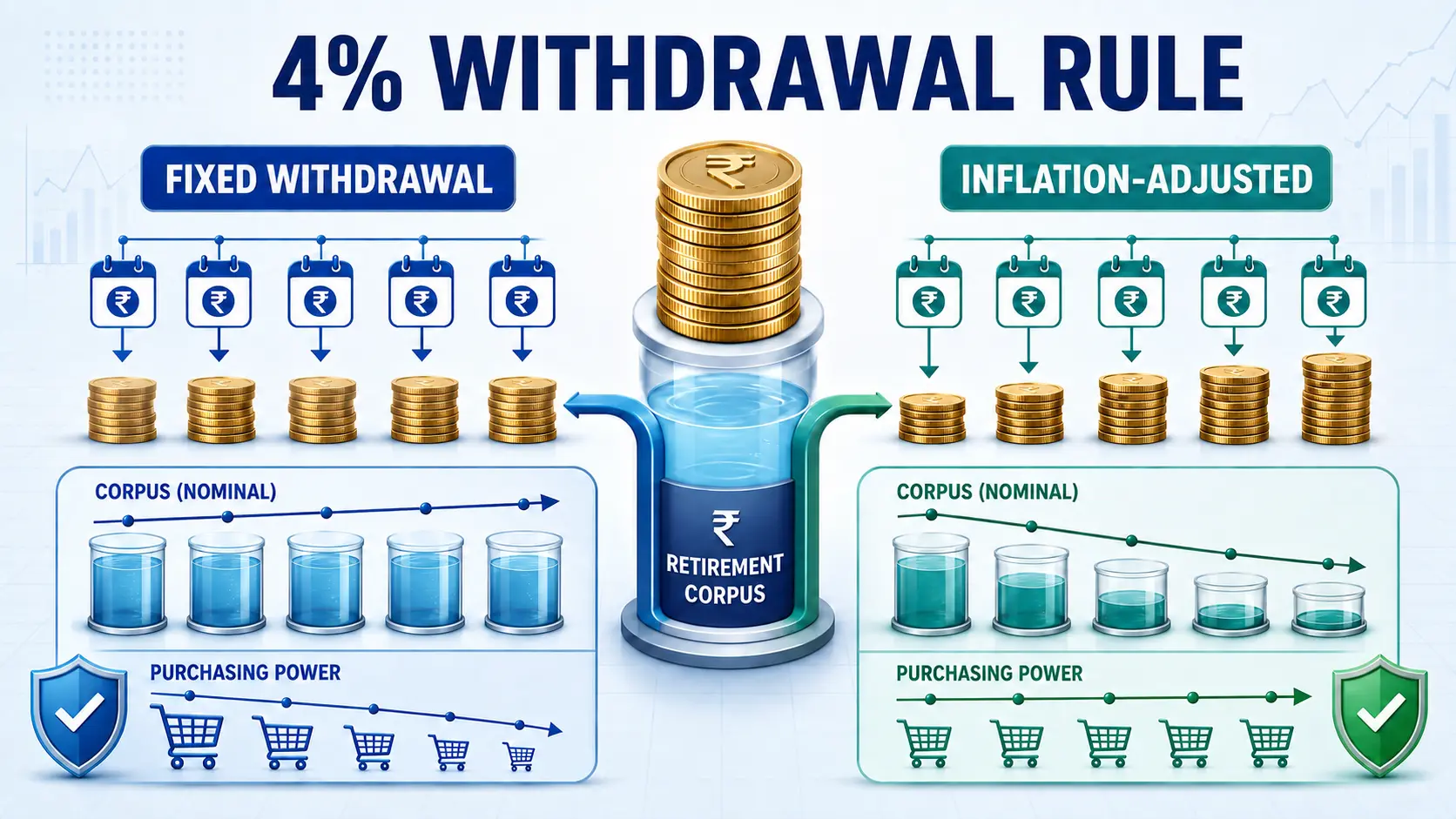
The conventional 4% rule does not mean withdrawing 4% of the current portfolio every year. It means withdrawing 4% of the initial corpus in the first year and then increasing that rupee amount with inflation in subsequent years.
The popular rule originated from research using historical US stock-and-bond returns and a retirement period of around 30 years. It is a planning guideline—not a guarantee or a directly transferable rule for every Indian retiree.
A Simple Example
Suppose you retire with:
- Retirement corpus: ₹1 crore
- Initial withdrawal: 4% = ₹4 lakh per year
- Portfolio return: 6% per year
At first glance, the maths appears comfortable.
Your ₹1 crore earns approximately ₹6 lakh in the first year, while you withdraw only ₹4 lakh.
So does that mean your corpus will keep growing forever?
Not necessarily. There are two different ways to look at the withdrawal.
Scenario 1: Fixed ₹4 Lakh Withdrawal—Not the Conventional 4% Rule
In the simplest model, you withdraw exactly ₹4 lakh every year. Your withdrawal does not increase with inflation.
If your corpus earns a steady 6% annually, the return in the early years is greater than the ₹4 lakh withdrawal.
In this simplified model, the corpus may not run out at all. In fact, it can continue growing in nominal rupee terms.
That sounds excellent—until we ask another question:
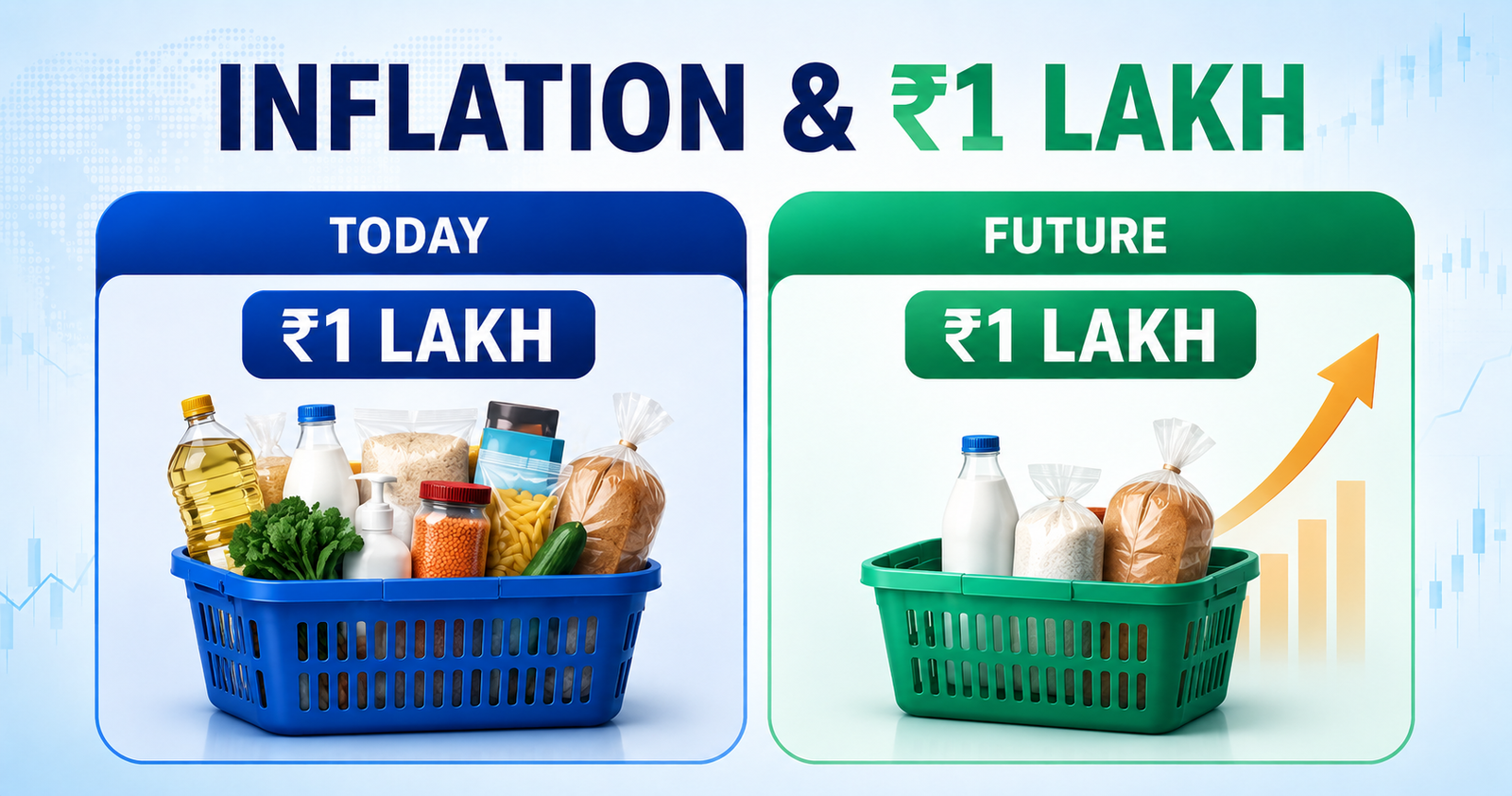
Will ₹4 lakh buy the same lifestyle 20 years from now?
Almost certainly not.
The Problem With a Fixed Withdrawal
Suppose your living expenses are ₹4 lakh today.
If inflation averages 6%, your expenses could roughly double in around 12 years.
So while you may still be withdrawing ₹4 lakh every year, its purchasing power keeps falling.
The corpus may survive, but your lifestyle may not.
That is why retirement planning should not look only at whether the corpus reaches zero. It should also ask:
Can the corpus continue supporting the same standard of living?
Scenario 2: Increase the Withdrawal With Inflation
Now consider a more realistic retirement plan.
You start by withdrawing ₹4 lakh in the first year. If inflation is 6%, the next year’s withdrawal becomes approximately ₹4.24 lakh.
The following year it increases again, and the process continues throughout retirement.
This is a very different calculation.
What Happens If Return and Inflation Are Both 6%?
Suppose:
- Portfolio return = 6%
- Inflation = 6%
Your nominal portfolio is growing at 6%, but your expenses are also growing at 6%.
Before investment costs and taxes, your real return is approximately 0%.
Real return = (1 + portfolio return) ÷ (1 + inflation) − 1
In this example:
(1.06 ÷ 1.06) − 1 = 0%
If you withdraw 4% of the original corpus in real purchasing-power terms every year, a corpus with zero real growth would theoretically last around 25 years.
Why? Because you are essentially spending about 4% of the original real corpus every year:
100 ÷ 4 = 25
This is a simplified illustration, but it shows how dramatically inflation changes the picture.
What If Inflation Is Lower Than the Return?
Suppose the portfolio still earns 6%, but inflation is only 5%.
(1.06 ÷ 1.05) − 1 ≈ 0.95%
Now your corpus is earning a small positive return after inflation. That extends how long it can support inflation-adjusted withdrawals.
If inflation is 4%:
(1.06 ÷ 1.04) − 1 ≈ 1.92%
The higher the real return, the longer the corpus can potentially last.
| Portfolio return | Inflation | Approx. real return | Approx. corpus life* |
|---|---|---|---|
| 6% | 4% | 1.92% | ~34 years |
| 6% | 5% | 0.95% | ~29 years |
| 6% | 6% | 0% | ~25 years |
*These estimates assume smooth annual returns, end-of-year withdrawals, no investment costs or taxes, and no changes in spending. They are mathematical illustrations—not forecasts.
Should We Reduce the 6% Return for Inflation?
This is where retirement calculations can become confusing.
If you are already increasing your annual withdrawal by inflation, you should generally continue using the nominal 6% return in that calculation.
Do not subtract inflation from the return again inside the same model. That would effectively count inflation twice.
Nominal Approach
- Use a 6% portfolio return
- Start with a ₹4 lakh withdrawal
- Increase the withdrawal every year with inflation
Real Return Approach
Alternatively, convert the investment return into a real return.
- Nominal return = 6%
- Inflation = 5%
- Real return ≈ 0.95%
Then keep the withdrawal constant in today’s purchasing-power terms.
Both approaches should lead to broadly similar results. The important thing is:
Don’t mix the two methods and adjust for inflation twice.
What About Fixed Deposits?
It may be tempting to assume that Fixed Deposit rates will move with inflation.
Interest rates often react to economic conditions, including inflation, but FD returns do not provide a guaranteed real return above inflation.
For example:
- FD return: 6%
- Inflation: 6%
Your pre-tax real return is approximately zero. After considering tax on FD interest, your real return could become negative.
So for retirement planning, it is better not to assume that an FD earning 6% automatically protects your purchasing power.
Why the 4% Number Alone Can Be Misleading
A withdrawal rate tells only part of the story.
A 4% withdrawal can behave very differently depending on:
- Portfolio return
- Inflation
- Taxation and investment costs
- Investment allocation
- Retirement duration
- Whether withdrawals increase every year
- Market conditions during retirement
Two retirees can both start with a 4% withdrawal rate and still experience very different outcomes.
Real Life Is Even More Complicated
So far, we have assumed that the portfolio earns exactly 6% every year.
Real markets do not work that way. A portfolio might earn:
- +12% one year
- −8% the next year
- +4% the year after that
Even if the long-term average return works out to around 6%, the order in which those returns occur can significantly affect a retiree who is regularly withdrawing money.
A major market fall during the first few years of retirement can be much more damaging than the same fall occurring much later. This is known as sequence-of-returns risk.
So the calculations in this article should be viewed as a starting point for understanding retirement sustainability—not as a prediction of how many years a real portfolio will last.
In a future article, we will examine sequence-of-returns risk more closely and discuss how bucket strategies, asset allocation and flexible withdrawals may help manage it.
The Bigger Lesson
The important retirement question is not:
“Is my withdrawal rate lower than my investment return?”
A better question is:
“After inflation, how much return is my corpus really earning while funding my lifestyle?”
A portfolio earning 6% with 6% inflation is very different from a portfolio earning 6% with 3% inflation.
The nominal return looks identical. The purchasing-power outcome is not.
Final Takeaway
Suppose you have ₹1 crore, withdraw ₹4 lakh in the first year and earn 6%.
If you keep withdrawing the same ₹4 lakh every year, the corpus may appear highly sustainable—but your purchasing power will steadily decline.
If you increase your withdrawal every year with inflation, the result changes dramatically.
- 6% return and 6% inflation: roughly 25 years in a simplified model
- 6% return and 5% inflation: roughly 29 years
- 6% return and 4% inflation: roughly 34 years
Retirement sustainability depends more on real return than nominal return.
In real retirement planning, inflation, taxes, investment costs, changing returns and sequence risk all need to be considered before deciding what withdrawal rate is sustainable.
Frequently Asked Questions
If my portfolio earns 6% and I withdraw 4%, will my corpus grow forever?
Only if the withdrawal remains fixed and the other simplified assumptions hold. If your withdrawals increase with inflation, the outcome can be very different.
Should I subtract inflation from the portfolio return?
You can calculate a real return, but don’t also increase withdrawals for inflation in the same calculation. Use either a nominal model or a real-return model consistently.
Is the 4% rule guaranteed?
No. It is a retirement-planning guideline, not a guarantee. Actual outcomes depend on market returns, inflation, taxes, investment costs, asset allocation and retirement duration.
Can FD returns protect me from inflation?
Not necessarily. FD rates may move with economic conditions, but they do not guarantee a positive real return after inflation and tax.
Disclaimer
This article is for educational purposes only and is not investment advice. The calculations shown are simplified illustrations using assumed fixed returns and inflation. Actual investment returns and inflation vary over time. Retirement planning should consider your goals, risk profile, taxation, investment costs, asset allocation and expected retirement duration.