
Tag: Asset Allocation

  • Large Cap vs Flexi Cap Mutual Funds: What’s the Difference and Which Fits Your Portfolio?

    Large Cap vs Flexi Cap Mutual Funds: What’s the Difference and Which Fits Your Portfolio?

    Quick answer: A large cap fund must keep most of its equity portfolio in India’s biggest listed companies. A flexi cap fund can move across large, mid and small companies. Neither category is automatically better. The more useful choice is the one that fits your goal, time horizon, risk capacity and existing investments.

    Large cap and flexi cap funds are often considered for the core of an equity portfolio. At first glance, the difference seems simple: one focuses on large companies, while the other has more freedom. In practice, that freedom changes how the fund may behave, what risks it can take and how it may overlap with the rest of your portfolio.

    Before comparing returns, it helps to understand what each category is designed to do.

    What is a large cap mutual fund?

    Under SEBI’s mutual-fund category framework, a large cap fund must invest at least 80% of its assets in large-cap stocks. Large-cap companies are generally the top 100 listed companies by full market capitalisation, based on the classification used for mutual funds.

    This rule gives the category a fairly clear identity. Most of the portfolio remains in established businesses with large market values. These companies may have longer operating records, wider access to finance and more diversified businesses than smaller companies. That does not make their shares safe or immune to falls. Their prices can still decline because of high valuations, weak results, regulation or broad market stress.

    A large cap fund can therefore provide focused exposure to the large-company part of the equity market. It may appeal to an investor who wants a relatively defined market-cap allocation instead of leaving that choice fully to the fund manager.

    What is a flexi cap mutual fund?

    A flexi cap fund must invest at least 65% of its assets in equity and equity-related instruments. Within its equity portfolio, the manager can invest across large-, mid- and small-cap companies without a fixed minimum allocation to each segment.

    This freedom is the category’s main feature. A manager may hold a large-cap-heavy portfolio at one point and add more mid- or small-cap exposure when opportunities appear attractive. The actual mix depends on the scheme’s strategy, the manager’s decisions and market conditions.

    Flexibility can help a manager look beyond one market-cap segment. It can also make the portfolio less predictable from its category name alone. Two flexi cap funds may have very different market-cap mixes, concentration levels and investment styles.

    Large cap vs flexi cap: the main differences

    Feature Large cap fund Flexi cap fund
    Core rule At least 80% in large-cap stocks At least 65% in equity and equity-related instruments
    Market-cap freedom Limited because most assets must remain in large caps Manager can change the mix of large, mid and small caps
    Portfolio predictability The large-cap bias is clear from the category The market-cap mix can change over time
    Risk tendency Usually less exposed to smaller-company risk, but still an equity fund Risk can rise when mid- and small-cap exposure increases
    Manager decision Security selection matters, but the market-cap range is narrower Both security selection and market-cap allocation matter
    Possible portfolio role A defined large-company equity allocation A diversified equity allocation with manager flexibility

    The table describes category rules, not a promise about outcomes. A flexi cap fund may sometimes resemble a large cap fund if it holds mostly large companies. A large cap fund can still be concentrated in a few sectors or stocks. The scheme’s current portfolio matters as much as its label.

    How might they behave across market cycles?

    Large-cap shares and smaller-company shares do not lead the market at the same time. When mid and small caps are rising strongly, a flexi cap fund with meaningful exposure to them may benefit. It may also fall more sharply if sentiment reverses. A flexi cap manager can reduce smaller-company exposure, but there is no guarantee that every shift will be timely or successful.

    A large cap fund stays closer to its defined segment. Its returns may therefore lag a broad rally led by smaller companies. It can also avoid taking a large direct exposure to that part of the market. This does not mean large cap funds always fall less. Portfolio concentration, valuations and business conditions can produce different results.

    Recent performance should not decide the category. The winner of the last one or three years may simply reflect which market segment was in favour. Your holding period is likely to include several such phases.

    Is a flexi cap fund always more diversified?

    No. Permission to invest across market caps does not ensure broad diversification. A flexi cap scheme may still hold a high share in large caps, a small number of stocks or a few sectors. Another scheme may spread its portfolio much more widely.

    Before investing, look at the latest factsheet. Check the market-cap split, top holdings, sector weights and number of stocks. Also review whether the portfolio has changed sharply. The aim is not to find a fund that never changes. It is to understand the kind of flexibility you are accepting.

    Can you hold both large cap and flexi cap funds?

    You can, but the combination needs a reason. Buying one of each does not automatically improve diversification.

    Suppose your flexi cap fund already keeps most of its money in large companies. Adding a large cap fund may increase exposure to the same leading stocks and sectors. You may then own two schemes without gaining a meaningfully different portfolio.

    Holding both may make sense when the large cap allocation has a defined role and the flexi cap fund brings a genuinely different strategy. Review the combined holdings and their weights. SEBI’s 2026 category framework has also strengthened the focus on schemes remaining true to their labels and on portfolio-overlap disclosures. Investors should still examine overlap at their own full-portfolio level.

    If you are comparing flexi cap with another diversified category, our guide to multi cap vs flexi cap funds explains how a fixed market-cap allocation differs from manager flexibility.

    Which category may fit your portfolio?

    A large cap fund may be considered when you want a clear allocation to established large companies and already have mid- and small-cap exposure elsewhere. It may also suit a plan in which each market-cap segment has a separate, deliberate weight.

    A flexi cap fund may be considered when you want one equity scheme that can invest across company sizes. It can suit investors who are comfortable allowing the manager to change that mix. You still need enough time to tolerate equity-market falls.

    Neither category is suitable merely because it has recently performed well. Money needed soon or on a fixed date may require assets with lower volatility. Your equity allocation should reflect the entire family balance sheet, including EPF, PPF, NPS, deposits, property, debt and other mutual funds.

    For a broader view of the risk differences between company sizes, read our guide to large cap, mid cap and small cap funds. Your ability to stay invested during a fall also matters, as explained in our article on matching investments to your risk profile.

    A practical checklist before you invest

    1. Define the goal: State what the money is for and when it will be needed.
    2. Set the equity allocation: Decide how much risk the goal and family finances can support.
    3. Identify the category’s job: Choose whether you need a fixed large-cap exposure or a manager-led market-cap mix.
    4. Inspect the actual portfolio: Review market-cap split, sectors, concentration and overlap with funds you already own.
    5. Study consistency: Look beyond recent returns to the scheme’s process, portfolio changes, risk and performance across market phases.
    6. Keep the structure simple: Add a fund only when it performs a distinct role.
    7. Review periodically: Rebalance when your goal, allocation or fund role changes—not because of short-term rankings.

    The current SEBI category framework is a useful starting point for understanding scheme labels. The regulator’s flexi cap circular explains the category’s equity requirement and flexibility across market capitalisations. A label narrows the search, but it cannot decide suitability on its own.

    The choice is about portfolio design, not a winner

    Large cap funds offer a more defined exposure to India’s largest listed companies. Flexi cap funds give the manager more room to search across company sizes. That flexibility may be useful, but it also makes the manager’s allocation decisions more important.

    Start with the role you need. Then check whether the actual scheme and its portfolio fulfil that role without unnecessary duplication. A financial plan should guide the fund choice—not the other way around.

    Disclaimer: This article is for general educational purposes and is not a recommendation to buy, sell or hold any mutual-fund scheme or security. Mutual fund investments are subject to market risks. Read all scheme-related documents carefully and consider your goals, risk profile and complete financial position before investing.


  • Mutual Funds or Direct Stocks: Which Role Should Each Play in Your Portfolio?

    Mutual Funds or Direct Stocks: Which Role Should Each Play in Your Portfolio?

    Quick answer: Mutual funds and direct stocks do not have to compete for the same role. Mutual funds can form a broad, expert-managed base. Direct stocks can form a smaller, more focused part for people who have the time and skill to track companies. The right mix depends on the family’s goals and full financial position.

    Investors often ask whether mutual funds or direct stocks are “better”. That question can lead to the wrong decision. Both invest in businesses, and both can rise or fall with the market. What changes is how the investments are selected, spread and monitored.

    A better question is: What job should each investment perform in the portfolio?

    The usual role of mutual funds

    A mutual fund pools money from many investors. A fund team invests it based on the scheme’s stated aim. This can make it easier to spread money across several companies instead of depending on a few holdings.

    For many families, mutual funds can form the core of long-term equity investing. They may suit regular SIPs and goals such as retirement or a child’s studies. They can also reduce the work of studying and tracking every company on its own.

    However, the label “mutual fund” does not mean that every scheme spreads money widely or suits every goal. Sector and thematic funds may still focus on a narrow area. Risk also differs across schemes. SEBI therefore requires mutual funds to display a Riskometer.

    The possible role of direct stocks

    Buying a share gives the investor direct exposure to one company. If the company does well, the investor may gain. But weak business results, a high purchase price, poor governance or an industry problem can also hurt the holding.

    Direct stocks may suit someone who wants to study businesses and can keep tracking them after purchase. This takes more than watching share prices. It may involve the company’s finances, rivals, key decisions and changing risks.

    For such an investor, direct stocks may play a focused role around a broad core. This can limit the harm that one wrong view may cause to key family goals. Direct stocks should not be treated as the “high-return part” of the portfolio. Putting more money into fewer companies can lead to both larger gains and larger losses.

    How their roles differ

    Question Mutual funds Direct stocks
    Main role Broad, managed exposure for a goal Focused ownership of selected companies
    Investor effort Choose a suitable fund type and review its role Research and monitor each company
    Key risk Choosing a fund type that does not match the goal Too much money in a few companies

    Can a portfolio contain both?

    Yes, but owning both is not always better. The mix works only when each has a clear role.

    For example, a family may use broad mutual funds for major long-term goals. A small direct-stock part may then be used for personal interest or ideas in which the investor has strong belief. Its size should reflect the investor’s skill and the loss the family can bear without harming key goals.

    The same company may appear inside a mutual fund and in the direct-stock portfolio. This can create a hidden large exposure. The full portfolio—not each account on its own—must therefore be reviewed.

    Common mistakes to avoid

    • Moving from mutual funds to stocks after seeing another investor’s recent gains.
    • Holding many stocks and assuming that the portfolio is properly diversified.
    • Buying direct stocks for money needed within a short or fixed period.
    • Comparing one successful stock with the average return of the entire mutual-fund portfolio.
    • Ignoring EPF, PPF, NPS, deposits, gold and other family assets when deciding the equity allocation.

    Begin with the family plan

    The decision should begin with the goal, not with the product. How soon will the money be needed? How much loss can the family bear? Is there enough time and interest to track companies? What other assets and loans already exist?

    SEBI’s investor material also asks people to review investments against their goals and ability to take risk. Its market learning resources cover both shares and mutual funds.

    For many people, mutual funds may remain the main way to invest in equity. Direct stocks may be absent or may have a limited support role. The balance could differ for a skilled investor. There is no single percentage for everyone.

    The important point is not whether mutual funds or direct stocks win. It is whether every holding has a clear purpose in the family’s financial plan.

    Disclaimer: This article is for general educational purposes and is not a recommendation to buy, sell or hold any security or mutual-fund scheme. Investments in securities markets are subject to market risks. Consider your goals, risk profile and complete financial position before investing.

  • Hybrid Mutual Funds Are Not All the Same: Understand the Different Types

    Hybrid Mutual Funds Are Not All the Same: Understand the Different Types

    “Hybrid fund” sounds like one kind of investment. It is not. Some hybrid funds hold more shares. Others hold more bonds. Some can change the mix over time.

    That difference matters more than the word hybrid on the label. Here is a simple way to understand the main types before discussing what may fit your family’s goals.

    What does a hybrid fund hold?

    A hybrid fund combines asset types. Shares can help with long-term growth, but their prices can fall sharply. Bonds can add income, but their prices and credit quality can also change. The mix shapes the fund’s risk.

    Holding both does not guarantee a smoother ride. Nor does it make the fund a substitute for an emergency reserve or a bank deposit.

    How the main types differ

    Fund type What to expect
    Conservative hybrid Mostly debt, with a smaller share component. It can still lose value.
    Balanced hybrid A mix of shares and debt. Neither side offers a guarantee against loss.
    Aggressive hybrid Mostly shares, with some debt. Expect meaningful ups and downs.
    Balanced advantage The manager can change the equity-debt mix. Funds may follow very different rules.
    Multi-asset Invests across at least three asset types. Check which ones and in what amounts.
    Equity savings Combines shares, debt and hedged equity. The label alone cannot tell you how much share-market risk remains.
    Arbitrage Usually seeks price differences between cash and futures markets. Returns vary; it is not an FD.

    These are broad descriptions, not a risk ranking. A scheme’s actual holdings and strategy can differ from another scheme in the same category. Check its current documents before drawing conclusions.

    Why the category is not enough

    Consider two balanced advantage funds. One may keep far more unhedged shares than the other. In the first, a falling market may have a much bigger effect. Both carry the same broad label.

    There is a similar trap with “equity exposure”. A fund can own shares and offset some price risk through futures. This is called hedging. The amount of equity it owns may then differ from the amount of share-market risk it retains. Ask for that distinction in plain language.

    Start with the family’s purpose

    Before discussing any fund, decide when the money will be needed. A fixed payment due soon needs a different approach from a long-term retirement goal. Also ask how much temporary loss the family could bear without abandoning its plan.

    Then review the whole portfolio. A hybrid fund may add little balance if the family already holds similar shares and bonds elsewhere. It may also duplicate an existing fund. The question is what role it serves, not how many categories the family owns.

    Finally, check the fund’s risk indicator, current asset mix, costs and exit terms. Discuss the possible downside as well as its role in the plan. Do not choose a fund only because its recent return looks attractive.

    Does one hybrid fund cover everything?

    Usually, no. A hybrid fund does not replace health cover, emergency cash or money reserved for near-term commitments. It also cannot meet every goal just because it holds several asset types.

    Takeaway: “Hybrid” tells you that a fund mixes assets. To judge its place in a family plan, look at the actual mix, the risks that remain and the date the money is needed. This article is educational, not a recommendation for any scheme.

    Category and scheme rules may change. Verify current portfolio disclosures, risk indicators, exit loads and tax treatment before acting. Further reading: SEBI mutual-fund categorisation circular and SEBI mutual-fund master circular.

  • Large Cap vs Mid Cap vs Small Cap Mutual Funds: What’s the Difference?

    Large Cap vs Mid Cap vs Small Cap Mutual Funds: What’s the Difference?

    Large-cap, mid-cap and small-cap mutual funds are often presented as three steps on a return ladder: large caps for stability, mid caps for balance and small caps for higher growth. That explanation is convenient—but incomplete.

    The labels first tell you the size of the companies in which a fund predominantly invests. They do not tell you whether a company is good or bad, whether a fund is suitable for your goal, or what return you will earn.

    The central idea: market capitalisation is a company-size classification. Your allocation among large-, mid- and small-cap funds should come from your financial plan, not from whichever category recently produced the highest return.

    What Does “Market Cap” Mean?

    Market capitalisation, or market cap, is the market value of all the outstanding shares of a listed company.

    Market capitalisation = current share price × number of outstanding shares

    For example, if a company has 10 crore outstanding shares and each share trades at ₹200, its market capitalisation is ₹2,000 crore. If its share price changes, its market cap changes too.

    This number is useful for comparing the size of listed companies, but it is not a quality score. A large company can have weak governance or poor growth prospects. A smaller company can have a strong business, but may still face greater uncertainty, lower liquidity or dependence on fewer products and customers.

    How India Classifies Large-, Mid- and Small-Cap Companies

    For mutual-fund categorisation in India, companies are ranked by full market capitalisation. The broad definitions are:

    • Large cap: the 1st to 100th companies
    • Mid cap: the 101st to 250th companies
    • Small cap: the 251st company onward

    The Association of Mutual Funds in India (AMFI) publishes the stock list used for this purpose based on data from recognised stock exchanges. The list is updated periodically, so a company can move from one market-cap segment to another as its relative market value changes.

    Important: “Small cap” does not mean a company below one permanently fixed rupee value. It means the company falls below rank 250 in the applicable market-cap list. The rupee size of the 250th company can change over time.

    How the Three Fund Categories Differ

    A category name describes the fund’s primary investment universe. It does not mean every rupee must remain in that segment. Under the prevailing category framework, a large-cap fund normally invests at least 80% of its assets in large-cap stocks, while mid-cap and small-cap funds normally invest at least 65% in their respective segments. The balance may be held in other permitted assets within the scheme mandate.

    Factor Large cap Mid cap Small cap
    Company ranks 1–100 101–250 251 onward
    Typical business stage More established, often with larger operations and access to capital Established but still expanding; may be moving towards market leadership Earlier or narrower stage; growth opportunity may come with greater business uncertainty
    Share liquidity Generally higher Generally moderate Can be lower, especially during market stress
    Price volatility Can be significant, but generally lower than the other two segments Usually higher than large cap Can be the highest and most abrupt
    Drawdown experience May fall sharply in an equity-market decline Falls can be deeper and recovery uneven Falls can be severe; recovery may take considerable time
    Growth visibility Often better researched, though mature businesses may grow more slowly Potentially stronger runway, with more execution risk Potential can be substantial, but outcomes vary widely
    Portfolio role Often forms the core of long-term equity exposure May add growth-oriented exposure around the core Usually a limited satellite allocation for suitable long-term goals

    The descriptions above are broad tendencies, not promises. Individual companies and funds can behave differently.

    Large Cap Does Not Mean Risk-Free

    Large-cap companies are usually established businesses with wider access to financing, greater analyst coverage and more actively traded shares. These qualities can make their stock prices relatively less volatile than those of smaller companies.

    But a large-cap fund is still an equity fund. Its value can fall because of an economic slowdown, changing interest rates, sector problems, expensive valuations, regulation, weak management decisions or a broad market decline. “Relatively less volatile” should never be read as “capital protected”.

    Large-cap exposure is often used as the core of an equity portfolio because it can provide participation in established businesses without concentrating the entire allocation in smaller companies. Whether that core should be an active fund, an index fund or part of a broader category is a separate portfolio decision.

    Mid Cap Is Not Simply the “Middle-Risk” Option

    Mid-cap companies may have moved beyond the fragile early stage but may still have room to expand their products, geography or market share. This combination can create attractive growth opportunities.

    It also creates execution risk. A business may need to invest heavily, manage debt, build distribution or defend itself against much larger competitors. Its shares may be less liquid than large-cap stocks, and disappointing results can produce sharper price movements.

    A mid-cap fund can therefore experience meaningful declines even when an investor calls their temperament “moderate”. The fund’s risk comes from what it owns; it does not change merely because the investor uses a moderate label.

    Small Cap Does Not Mean “Guaranteed Higher Return”

    Small companies can grow rapidly from a lower base. Some may eventually become mid- or large-cap businesses. This possibility attracts investors—but it is only one possible outcome.

    Smaller companies may depend on fewer customers, products or key employees. They may find financing harder during difficult periods, receive less research coverage, and trade with lower liquidity. Governance and disclosure risks may also be harder for ordinary investors to evaluate.

    These characteristics can produce strong rallies as well as deep, prolonged declines. A small-cap fund spreads money across several companies and relies on professional management, but diversification cannot remove market risk or guarantee that the category will outperform large caps.

    Why Recent Returns Can Give the Wrong Answer

    Market-cap segments do not lead in a fixed order. In one phase, smaller companies may rally because economic expectations and investor confidence are strong. In another, money may move towards larger, more liquid businesses. Valuations also matter: even a good company can become a poor investment if its price assumes unrealistically high growth.

    This is why selecting the best-performing category of the last one or three years can become a cycle of buying after prices have already risen and selling after the next decline.

    A useful question is not: “Which market-cap category will give the highest return?”
    It is: “How much uncertainty can this goal absorb, and what role should each segment play in the entire family portfolio?”

    Time Horizon Matters—but It Is Not the Only Test

    A longer horizon gives an investor more time to live through market declines, but time alone does not make an unsuitable allocation suitable. Consider four factors together:

    1. Goal horizon: When will the money be needed?
    2. Goal flexibility: Can the goal be postponed or reduced if markets are down?
    3. Risk capacity: Can the family absorb a fall without compromising essential commitments?
    4. Investment temperament: Can the investor remain disciplined through a deep and extended decline?

    For example, retirement in 15 years and a discretionary second-home goal in 15 years have the same horizon but not the same importance. The retirement allocation may need a more resilient structure because failure has more serious consequences.

    Emergency money, near-term school fees, insurance premiums and other predictable commitments generally should not depend on equity-market conditions—whether the fund is labelled large, mid or small cap.

    Equal Allocation Is Not Automatically Diversification

    After learning about the three segments, an investor may be tempted to divide equity equally: one-third large cap, one-third mid cap and one-third small cap. There is no rule that makes this mix appropriate.

    Your existing funds may already contain all three segments. A flexi-cap fund can move across market caps, a multi-cap fund maintains prescribed exposure across the three, and a large-and-mid-cap fund combines two segments. Adding separate funds without examining the underlying allocation can unintentionally create excessive mid- and small-cap exposure or repeated ownership of the same stocks.

    For a more detailed explanation of the category structure, read Multi Cap vs Flexi Cap Funds: What’s the Difference?

    A Better Way to Decide the Allocation

    Start with the family plan, not a fund-ranking page.

    1. Separate essential reserves. Keep emergency savings and near-term commitments outside volatile equity allocations.
    2. Define each goal. Record the amount, date, importance and flexibility.
    3. Decide total equity exposure. This should reflect the goal and the family’s risk capacity—not only its willingness to take risk.
    4. Choose the role of each market-cap segment. Large cap may form a core; mid and small cap may be added in measured proportions where suitable.
    5. Review the complete portfolio. Include mutual funds held across family members and platforms, plus EPF, PPF, NPS, deposits, property, liabilities and insurance needs.
    6. Rebalance deliberately. Restore the intended allocation periodically or after a material drift instead of chasing the category that recently performed best.

    This process does not identify one universally “best” category. It produces an allocation connected to real goals and a family’s ability to stay invested.

    You may also find our two-part investor-profile series useful: Are You Really a Conservative, Moderate or Aggressive Investor? and How Should Your Investing Approach Change?

    Frequently Asked Questions

    1. What is the simplest difference between large, mid and small cap?

    They are company-size buckets based on full-market-cap ranking. Large caps are ranks 1–100, mid caps 101–250, and small caps rank 251 onward under the classification used for Indian mutual funds.

    2. Are large-cap mutual funds safe?

    They may be relatively less volatile than mid- or small-cap funds, but they are not risk-free. Their NAV can fall, and neither capital nor returns are guaranteed.

    3. Do small-cap funds always earn higher returns over the long term?

    No. Small companies may have greater growth potential, but they also face greater business, valuation and liquidity risks. A long holding period improves the ability to withstand volatility; it does not guarantee outperformance or prevent loss.

    4. How long should I hold a mid- or small-cap fund?

    There is no holding period after which these categories become safe. They are generally considered only for long-term goals with enough flexibility and for investors who have both the financial capacity and temperament to withstand deep declines.

    5. Can one mutual fund invest across all three market caps?

    Yes. Categories such as flexi cap and multi cap can invest across large-, mid- and small-cap companies, although their allocation rules differ. Always check the scheme’s current mandate and actual portfolio.

    Final Takeaway

    Large-, mid- and small-cap labels help describe where a mutual fund invests. They should not be converted into shortcuts such as “large cap is safe” or “small cap gives the best return”.

    A sensible portfolio can contain more than one market-cap segment, but the proportions should follow the investor’s goals, total equity allocation, risk capacity, temperament and existing holdings. Fund selection comes after that structure—not before it.

    Want to understand how your current mutual funds fit together?
    Review the complete family portfolio and its goals before adding another category.
    Speak with Vibhu360

    Sources and Further Reading

    Disclaimer

    This article is for educational purposes only and is not investment advice or a recommendation to invest in any mutual fund, market-cap segment or security. Mutual fund investments are subject to market risks. Category rules, market-cap classifications, scheme mandates, portfolios, benchmarks, riskometers, taxation and exit loads can change; verify the latest scheme documents and applicable regulations before acting. Consider your financial goals, risk capacity, investment temperament and time horizon, and consult a qualified professional where appropriate.

  • Conservative, Moderate or Aggressive: How Should Your Investing Approach Change?

    Understanding the Investor — Part 2

    Knowing whether you have a conservative, moderate or aggressive investment temperament is useful. It helps explain how you may react when markets fall, returns disappoint or outcomes remain uncertain.

    But it does not answer the next—and more important—question:

    How should you actually invest?

    An aggressive temperament does not make equity suitable for school fees due in two years. A conservative temperament does not make it safe to ignore inflation while preparing for retirement twenty years away. Your investor type can influence how a plan is designed and implemented, but it cannot independently decide the portfolio.

    The central idea: Your temperament tells us what investment journey you may be able to tolerate. Your finances and goals tell us which journeys are available to you.

    In Part 1 of this series, we separated investment temperament from risk capacity. Here, we turn that distinction into a practical investing approach—without using a one-size-fits-all asset-allocation formula.

    What your investor type should influence

    Your temperament should influence the way a portfolio is experienced and managed. This includes how much fluctuation you can live with, how gradually market-linked investments are introduced, how often the plan is reviewed and how much explanation or behavioural support you may need during difficult markets.

    It should not automatically produce a standard equity-to-debt percentage. Two moderate investors can require very different portfolios because their goals, cash flows, responsibilities and time horizons are different.

    Investor temperament Helpful approach Behavioural risk to manage
    Conservative Introduce market-linked risk gradually, explain possible declines before investing and use a plan the investor can remain with during volatility. Abandoning long-term investments after a fall or avoiding necessary growth exposure because every fluctuation feels unsafe.
    Moderate Maintain clear boundaries between stability and growth assets, diversify and review through a defined process rather than reacting to headlines. Becoming aggressive after strong markets and conservative after declines, causing the portfolio to drift with sentiment.
    Aggressive Use growth exposure only where the goal and capacity permit it, while retaining diversification, liquidity and allocation limits. Confusing comfort with volatility for immunity from loss, then concentrating in small caps, sectors, themes or recent winners.

    These are implementation principles, not model portfolios. The suitable product mix must still be determined separately for each investor and each goal.

    Step 1: Check whether the financial foundation is ready

    Emergency savings, insurance and debt questions belong here. They do not determine whether you are emotionally conservative or aggressive. They help determine whether investing—and particularly taking market risk—is financially sensible at this stage.

    Before committing money intended for the long term, review:

    • Whether adequate emergency money is available for essential expenses
    • Whether health insurance and necessary life cover are in place
    • Whether costly debt or an unstable cash flow requires attention
    • Whether predictable annual expenses such as school fees, insurance premiums and major renewals have been provided for
    • Whether the planned investment can continue without repeatedly being withdrawn for routine needs

    A person can have an aggressive temperament and still be financially unready for an aggressive portfolio. Correcting the foundation is not a change in personality; it is sensible sequencing.

    Step 2: Give every goal its own risk limit

    An investor does not have just one time horizon. Retirement, a house purchase, school fees, a holiday and emergency reserves may all coexist, but the money for each has a different job.

    Goal characteristic Question to consider Effect on the approach
    Time available When will the money first be required? A shorter recovery period generally reduces the room for market-linked volatility.
    Importance What happens if the required amount is not available on time? Essential goals require greater reliability than discretionary goals.
    Flexibility Can the date, amount or scope of the goal be changed? Flexible goals may permit more uncertainty than fixed commitments.
    Funding progress How much has already been accumulated? As an essential goal approaches or becomes adequately funded, protecting it can become more important than seeking additional growth.

    This is why assigning one risk label to the investor and applying it to every rupee can be misleading. The same aggressive investor may appropriately use very different approaches for a two-year commitment and a twenty-year goal.

    Step 3: Assess the capacity to absorb a loss

    Risk capacity asks what a decline would do to your real financial life—not merely how it would make you feel.

    Someone with stable income, adequate reserves, limited liabilities and flexible long-term goals may have considerable capacity. Someone supporting dependants, managing large repayments or approaching an essential goal may have less capacity, even if that person remains calm during market declines.

    Capacity can also change. A job transition, new loan, childbirth, health event or approaching goal can reduce it. A rise in income or completion of a major liability can increase it. Therefore, the investment approach needs periodic review rather than a permanent label assigned once.

    Step 4: Estimate the return the goal appears to require

    A plan sometimes appears to require a high return because the contribution is too small, the goal is expensive or the time available is short. This is often described as the investor’s “required risk”.

    But an unrealistic required return is not permission to take unsuitable risk. If the numbers do not work using reasonable assumptions, the first options to examine are increasing the investment, extending the goal date where possible, reducing the target or reprioritising goals.

    Important: Taking more risk can increase uncertainty; it does not guarantee that a shortfall will be solved. A plan should not depend on unusually high returns simply because the desired goal is otherwise unaffordable.

    Step 5: Combine the factors—do not average them blindly

    A very high score in one area cannot erase a serious limitation in another. Strong willingness to take risk cannot make a near-term essential goal flexible. High financial capacity cannot ensure that a nervous investor will stay invested during a severe decline.

    The practical portfolio should respect the tightest meaningful constraint while still giving long-term goals a reasonable opportunity to grow. This requires judgement, not merely adding questionnaire scores.

    Three examples

    1. Aggressive temperament, weak financial foundation

    Ravi is comfortable with equity volatility but has no emergency reserve and regularly uses credit to meet annual expenses. His temperament may genuinely be aggressive, but the immediate priority is strengthening cash-flow resilience. An aggressive label should not be used to justify exposing money needed for foreseeable expenses to market declines.

    2. Conservative temperament, distant retirement goal

    Lakshmi dislikes losses and prefers predictable investments. Her retirement is still twenty years away. Avoiding all growth exposure may create inflation and adequacy risks, but forcing her into a portfolio she is likely to abandon is equally unhelpful. Her approach may require gradual exposure, realistic expectations and a review process that supports staying invested.

    3. Moderate temperament, several simultaneous goals

    Farhan is comfortable with moderate fluctuations. He has school fees due in three years, a house goal in eight years and retirement after twenty-five years. Using one “moderate portfolio” for all three can mix incompatible timelines. Separating the goals allows each pool of money to take only the risk its purpose permits.

    A guided portfolio discussion checklist

    Before discussing products or funds, an investor and financial professional should be able to answer the following:

    1. Readiness: Is essential protection and short-term liquidity in place?
    2. Purpose: What exact goal is this investment intended to fund?
    3. Timeline: When could withdrawals begin, and how flexible is that date?
    4. Capacity: What would happen to the goal and household finances after a material loss?
    5. Temperament: What is the investor likely to do during a prolonged decline?
    6. Adequacy: Are the contribution and return assumptions reasonable?
    7. Implementation: Is the portfolio diversified, understandable and simple enough to review?

    The answers should lead to a documented investment approach. They should not be converted mechanically into a product recommendation.

    Common mistakes to avoid

    • Using age as the portfolio: Age can influence capacity and horizon, but it does not capture goals, liabilities or behaviour.
    • Applying one label to every goal: Money needed at different times should not automatically follow the same risk approach.
    • Equating aggressive with concentrated: Willingness to accept risk does not remove the need for diversification.
    • Equating conservative with no risk: Inflation, reinvestment risk and failure to accumulate enough are also financial risks.
    • Changing the approach with the market: A plan created after a rally and abandoned after a fall is being driven by recent returns rather than the investor’s goals.

    Frequently asked questions

    Does every conservative investor need the same portfolio?

    No. The label describes a behavioural tendency. The suitable portfolio depends on the investor’s goals, capacity, existing assets, liabilities and time horizons.

    Can an aggressive investor hold low-volatility investments?

    Yes. Emergency reserves, near-term commitments and essential goals may require stability regardless of temperament.

    Should every long-term goal have high equity exposure?

    No. A long horizon can provide greater capacity to recover from fluctuations, but it does not by itself establish suitability. The investor’s behaviour, financial capacity, goal importance and overall portfolio also matter.

    How often should the approach be reviewed?

    A review is useful periodically and after material changes in income, family responsibilities, liabilities, health, goals or withdrawal timelines. A market movement alone does not necessarily require changing the plan.

    Final takeaway

    Conservative, moderate and aggressive are useful descriptions of investment temperament—not ready-made portfolios.

    The right approach begins with financial readiness, separates money by goal, respects both willingness and capacity, and uses reasonable assumptions. Your investor type helps make that plan sustainable, but it should never be allowed to replace the plan.


    Regulatory context: SEBI’s Investment Advisers Regulations require registered investment advisers to assess both the risk a client is willing and able to take, including capacity to absorb loss, and to consider investment objectives and financial circumstances when assessing suitability. SEBI does not prescribe a universal conservative–moderate–aggressive portfolio allocation.

    Sources: SEBI Investment Advisers Regulations, 2013, amended up to 25 November 2025; SEBI Master Circular for Investment Advisers, 6 February 2026; and SEBI Investor: Understanding Investment Advisers.

    Disclaimer: This article is for investor education only. It does not constitute investment advice, a formal risk-profiling exercise or a recommendation to invest in any asset, product or mutual fund scheme. Mutual fund investments are subject to market risks; read all scheme-related documents carefully.

  • Are You Really a Conservative, Moderate or Aggressive Investor?

    Are You Really a Conservative, Moderate or Aggressive Investor?

    Imagine two investors.

    Arun has a home loan and school expenses. He also remains calm when equity markets fall and is willing to wait through several difficult years. Meera has no loans and a large emergency reserve, but even a small decline in her investments makes her uncomfortable.

    Who is the aggressive investor?

    Emotionally, it may be Arun. Financially, however, his commitments may restrict how much investment risk he can prudently take. Meera may have a greater capacity to absorb losses but a lower willingness to experience them.

    This is why questions about age, income, insurance, loans and emergency savings cannot, by themselves, tell you whether you are a conservative, moderate or aggressive investor. They are important questions—but they answer a different part of the financial-planning problem.

    The essential distinction: Investment temperament describes how you feel and behave when outcomes are uncertain. Risk capacity describes how much loss your finances and goals can withstand.

    Why investor labels are often confusing

    Many risk-profiling tools combine several dimensions into one score. This can be useful when a professional is assessing suitability, but it can confuse a reader who is simply trying to understand their natural response to investment risk.

    For example, an outstanding loan may reduce your capacity to bear a loss. It does not necessarily change whether market volatility makes you anxious. Similarly, being young may provide more time for a distant goal, but age does not guarantee that you will remain invested during a severe market fall.

    Question being answered What it examines Typical information considered
    What is my investment temperament? Your emotional willingness to accept uncertainty and temporary losses Reaction to market falls, preference for certainty, past behaviour and comfort with fluctuations
    How much risk can I financially bear? Your capacity to withstand losses without damaging essential commitments Income stability, liabilities, emergency reserves, insurance, dependants and available surplus
    What risk is suitable for a particular goal? The risk permitted by that goal’s timeline, importance and flexibility Time horizon, target amount, withdrawal date, ability to postpone the goal and consequences of a shortfall

    A responsible portfolio decision considers all three questions. This article intentionally addresses only the first: your investment temperament.

    Investment-temperament self-check

    Answer according to what you are genuinely likely to do—not what you think a “good investor” is expected to choose. There are no superior or inferior results.

    1. Which investment outcome would trouble you more?
    2. An investment of ₹10 lakh falls to ₹8.5 lakh during a broad market decline. Your goal and circumstances have not changed. What are you most likely to do?
    3. Which experience would you be most comfortable accepting from a long-term investment?
    4. Your investment remains below its earlier peak for eighteen months. What best describes your likely response?
    5. During periods of negative market news, what are you most likely to do?
    6. If you have experienced a major market fall before, which response is closest to yours?

    This educational self-check does not collect, transmit or store your answers. Its result is indicative and is not a formal risk-profile or investment recommendation.

    Understanding your result

    Conservative investment temperament

    You place greater importance on predictability and capital stability. Material fluctuations may create discomfort or make it difficult for you to stay with the original investment plan.

    This does not mean that you should avoid every market-linked investment. It means any plan containing volatility must account for your ability to remain committed during uncomfortable periods.

    Moderate investment temperament

    You generally seek a balance between stability and growth. You can accept some fluctuations, but prolonged or unusually large declines may require explanation, reassurance and a structured review.

    Moderate is not a fixed midpoint that automatically translates into a standard equity-to-debt ratio. Your allocation still depends on each goal and your financial capacity.

    Aggressive investment temperament

    You appear more willing to accept uncertainty and substantial temporary declines in pursuit of long-term growth. You may be less likely to abandon a plan merely because markets have fallen.

    This willingness does not prove that you can afford large losses. An aggressive investor can still require a conservative investment approach for a near-term or essential goal.

    Why your result cannot decide your portfolio

    Suppose an aggressive investor needs money for school fees in two years. The short timeline and importance of the expense can require stability even though the investor is personally comfortable with market risk.

    Now consider a conservative investor preparing for retirement twenty years away. Avoiding growth assets entirely may expose the goal to inflation and an inadequate corpus. The answer is not to force that investor into a volatile portfolio, but to design an allocation, contribution level and review process the investor can realistically sustain.

    In practice, the suitable level of risk is constrained by the weakest relevant factor. High willingness cannot compensate for an inability to bear losses, and a strong financial position cannot remove emotional discomfort.

    Before acting on the result: Review emergency reserves, essential insurance, liabilities, income stability, goal timelines and the consequences of a shortfall. These are planning inputs—not personality questions.

    What professional risk profiling considers

    SEBI does not prescribe a universal question bank or an official scoring scale for the labels conservative, moderate and aggressive. Its Investment Advisers Regulations instead require registered investment advisers to obtain relevant client information and assess both the risk a client is willing to take and the risk the client is able to take.

    The regulations refer to information such as age, investment objectives and horizon, income, existing assets, risk tolerance and liabilities. They also require questionnaire wording to be fair, clear and non-leading, and require responses to be interpreted appropriately.

    AMC risk profilers commonly ask about capital protection versus growth, reaction to a market fall and comfort with uncertain outcomes. Many also ask about age, savings, loans or investment horizon because their tools are trying to estimate more than temperament. This self-check intentionally keeps those dimensions separate.

    Frequently asked questions

    Does having a loan make me a conservative investor?

    No. A loan can reduce your financial capacity to take investment risk, but it does not determine how comfortable you feel about volatility. Both dimensions must be considered separately.

    Can my investment temperament change?

    Yes. Knowledge, experience and actual exposure to market declines can change how you respond. A result obtained during a rising market may also differ from your behaviour during a severe fall.

    Does aggressive mean better?

    No. Conservative, moderate and aggressive are descriptions, not performance rankings. The useful result is the one that reflects your genuine behaviour.

    Can I use this result to select mutual funds?

    Not by itself. Fund selection must consider the purpose of the investment, time available, liquidity needs, portfolio allocation, product risk and your capacity to bear loss. Consider reviewing these factors with a qualified professional.

    Final takeaway

    Your reaction to uncertainty matters because even a technically sound portfolio can fail if you cannot remain invested through its difficult periods. But your emotional willingness is only one part of suitability.

    First understand your temperament. Then examine what your finances and individual goals permit. A suitable investment plan must respect both.


    Sources: SEBI Investment Advisers Regulations, 2013, amended up to 25 November 2025; SEBI Master Circular for Investment Advisers, 6 February 2026; SBI Mutual Fund risk assessment; Mirae Asset Mutual Fund Risk Profiler; and Axis Mutual Fund discussion of risk profiling.

    Disclaimer: This article and assessment are for investor education only. They do not constitute investment advice, a formal risk-profiling exercise or a recommendation to invest in any asset, product or mutual fund scheme. Mutual fund investments are subject to market risks; read all scheme-related documents carefully.

  • Small-Cap SIP Assets Have Grown 5x: Should You Increase Yours?

    Small-Cap SIP Assets Have Grown 5x: Should You Increase Yours?

    Small-cap mutual funds have attracted significant SIP money over the
    past five years.

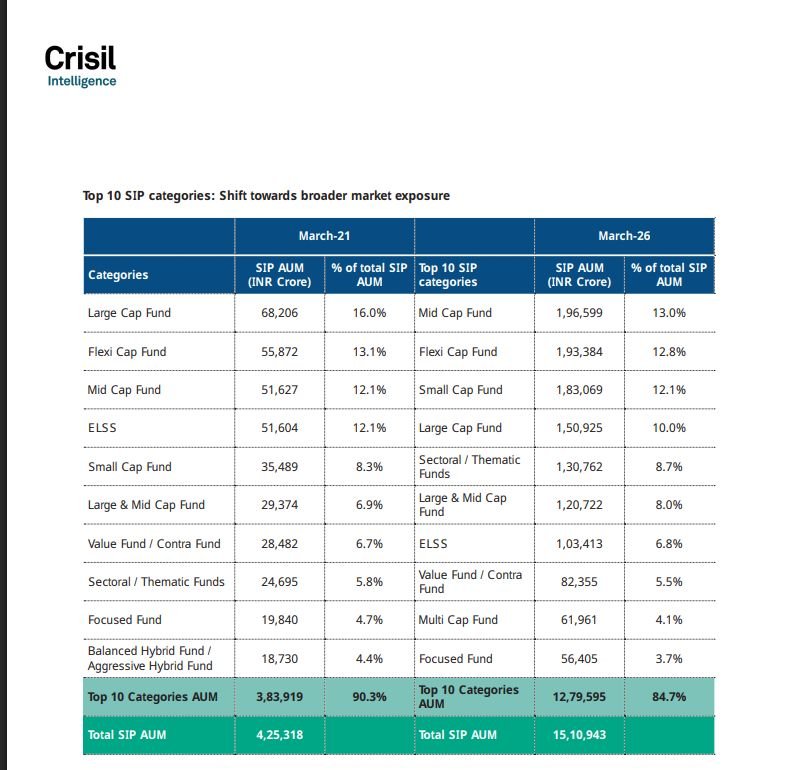
    According to the AMFI–Crisil Factbook 2026, SIP
    assets in small-cap funds increased from ₹35,489 crore in March
    2021 to ₹1,83,069 crore in March 2026
    . That is an increase of
    approximately 5.2 times in five years.

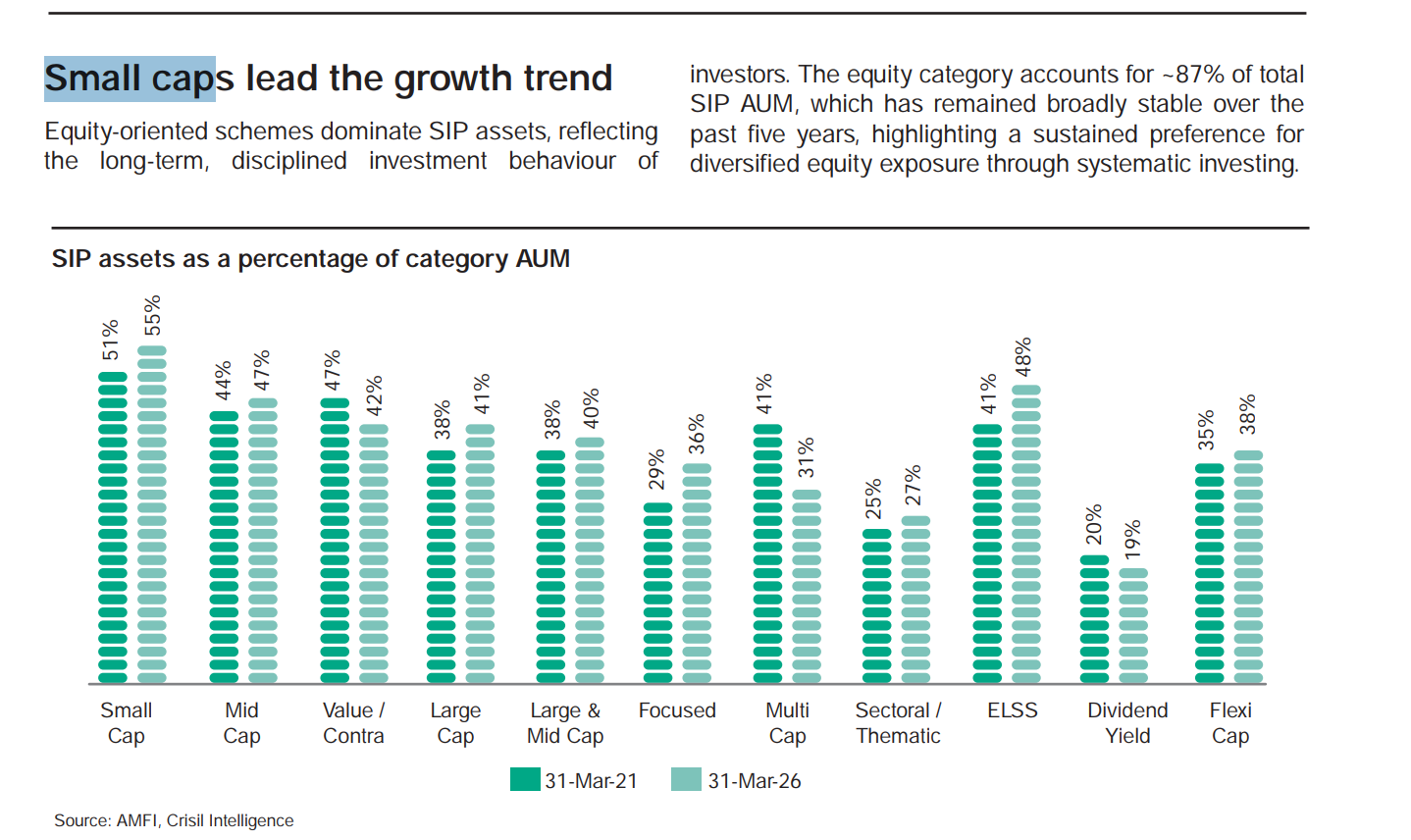
    The report also states that SIP assets represented 55% of the
    total assets in the small-cap fund category
    as of March
    2026—the highest proportion among the equity-fund categories shown in
    the report.

    These figures demonstrate how strongly investors have embraced
    small-cap SIPs. But do they also mean that you should increase
    yours?

    Not necessarily.

    The growth of an investment category tells us where investors have
    been putting their money. It does not tell us whether that category is
    attractively valued today, whether it will outperform next, or whether
    it is suitable for a particular investor.

    What Does the 55% Figure
    Actually Mean?

    The 55% figure can easily be misunderstood.

    It does not mean that small-cap funds received 55%
    of all SIP investments in India. It also does not represent a return
    earned by investors.

    It means that, as of March 2026, the value of assets accumulated
    through SIPs in small-cap schemes accounted for approximately
    55% of the total AUM of the small-cap fund
    category
    .

    The same chart shows that this proportion was 51% in March 2021. The
    increase from 51% to 55% is meaningful, but the much larger change is
    visible in the absolute SIP assets accumulated in the category.

    The factbook’s category table shows:

    Small-cap SIP data March 2021 March 2026
    SIP AUM ₹35,489 crore ₹1,83,069 crore
    Share of total industry SIP AUM 8.3% 12.1%

    Therefore, the accurate conclusion is:

    Small-cap SIP assets grew by approximately 5.2
    times—not necessarily the total AUM of small-cap funds and certainly not
    investor returns.

    AMFI-Crisil table showing small-cap SIP AUM increasing from ₹35,489 crore in March 2021 to ₹1,83,069 crore in March 2026.
    Leading mutual-fund categories by SIP AUM in March 2021 and March 2026. Source: AMFI-Crisil Factbook 2026.

    Why Have Small-Cap
    SIP Assets Grown So Much?

    The increase is likely the result of several forces acting
    together:

    • More investors have entered mutual funds through monthly SIPs.
    • Strong historical periods for smaller companies attracted investor
      attention.
    • Investment platforms have made starting and managing SIPs
      easier.
    • Small monthly investments can make a volatile category feel more
      approachable.
    • Investors increasingly associate small-cap companies with higher
      long-term growth potential.

    However, a category often becomes most popular after
    it has delivered attractive returns. This can encourage investors to
    increase exposure based on recent performance rather than their
    financial plan.

    That is why rising SIP participation should be treated as a trend to
    understand—not as a buy signal.

    A SIP
    Changes How You Invest, Not What You Invest In

    A SIP spreads investments across different market levels instead of
    committing the entire amount on one day. This can reduce the risk of
    investing a large lump sum at an unfavourable time and helps build
    investing discipline.

    But a SIP does not remove the underlying risk of the asset.

    If small-cap stocks decline sharply, a small-cap fund can also
    experience a substantial fall. Continuing the SIP during that period may
    allow the investor to accumulate more units at lower NAVs, but the
    portfolio value can still remain below the invested amount for an
    extended period.

    A SIP therefore does not:

    • guarantee positive returns;
    • prevent short-term or medium-term losses;
    • make every fund suitable for every investor;
    • compensate for an excessive small-cap allocation; or
    • turn a short investment horizon into a long one.

    The discipline of a SIP is valuable only when the investor can remain
    invested through the category’s difficult periods.

    Why Small-Cap Funds Need
    More Patience

    Under the mutual-fund categorisation framework, small-cap companies
    are generally those ranked 251st onwards by full market
    capitalisation
    . A small-cap fund is required to invest at least
    65% of its assets in small-cap stocks.

    Compared with established large companies, smaller companies may
    have:

    • less diversified businesses;
    • lower trading liquidity;
    • greater dependence on a few customers or products;
    • more sensitivity to economic slowdowns;
    • limited ability to raise capital during difficult periods; and
    • wider differences between successful and unsuccessful
      businesses.

    This does not make small-cap funds unsuitable. It means that the
    potential for higher growth comes with greater uncertainty, deeper
    volatility and the possibility of prolonged underperformance.

    An investor who needs the money in three or five years may not have
    enough time to wait for the category to recover from an unfavourable
    market cycle. Small-cap exposure is generally more appropriate for goals
    that are at least seven to ten years away, with the
    understanding that even a long horizon does not guarantee a particular
    return.

    Should You Increase Your
    Small-Cap SIP?

    The answer should depend on your allocation—not on the industry’s
    growth statistics.

    Consider increasing it only
    when:

    • your financial goal is sufficiently long-term;
    • your emergency fund and near-term requirements are already
      covered;
    • small caps currently form less than your planned allocation;
    • you understand the small-cap exposure already present in your
      flexicap, multicap or other equity funds;
    • you can continue investing through a sharp decline; and
    • the increase is part of a portfolio plan rather than a response to
      recent returns.

    Maintain the existing SIP
    when:

    • the current allocation is already close to your target;
    • the SIP amount remains appropriate for the goal;
    • your risk capacity and time horizon have not changed; and
    • recent category popularity is the only reason you are considering an
      increase.

    Consider reducing or
    redirecting it when:

    • small caps have become an excessive part of your equity
      portfolio;
    • you hold several small-cap funds with substantial portfolio
      overlap;
    • an important goal is getting closer;
    • market falls are causing you to stop or frequently change SIPs;
      or
    • you selected the category mainly because it had recently delivered
      high returns.

    Measure
    Small-Cap Exposure Across the Entire Portfolio

    Looking only at the fund named “Small Cap” can understate your actual
    exposure.

    Flexicap, multicap, focused, value and some thematic funds may also
    hold small-cap stocks. If you own several such schemes, your total
    small-cap exposure can be higher than expected.

    For example, suppose equity represents 70% of your overall investment
    portfolio and you decide that small caps should represent 15% of the
    equity portion.

    Your small-cap allocation at the total-portfolio level would be:

    70% × 15% = 10.5% of the overall portfolio

    The correct comparison is between this target and your combined
    small-cap exposure across every fund—not merely the value of your
    dedicated small-cap scheme.

    A Practical Way to
    Manage the Allocation

    Instead of changing the SIP based on headlines, use a simple
    process:

    1. Identify the goal: Confirm when the money will be
      required.
    2. Calculate existing exposure: Include small-cap
      holdings inside all equity schemes.
    3. Set a target range: Use a range rather than
      expecting the allocation to remain at one exact percentage.
    4. Direct new SIPs thoughtfully: Add money to an
      underweight category instead of automatically choosing the recent
      winner.
    5. Review periodically: Review annually or when the
      allocation moves materially outside its target—not every time markets
      fluctuate.

    This approach turns the decision from “Are small-cap funds doing
    well?” into the more useful question: “Does my current allocation still
    suit my goal and my ability to handle risk?”

    The Takeaway

    The rise of small-cap SIP assets from ₹35,489 crore to ₹1,83,069
    crore is a significant change in Indian investor behaviour. It shows
    that SIPs have become an important route for participating in small-cap
    funds.

    But popularity is not the same as suitability.

    A small-cap SIP can play a useful role in a diversified, long-term
    portfolio. Whether you should start, increase or maintain one depends on
    your goal, investment horizon, existing exposure and ability to remain
    invested through severe volatility.

    The AMFI–Crisil data gives us a reason to examine our allocation. It
    does not give everyone a reason to increase it.


    Sources

    This article is for educational purposes only and should not be
    treated as investment advice or a recommendation to invest in any
    particular mutual-fund scheme. Mutual-fund investments are subject to
    market risks. Read all scheme-related documents carefully and consider
    consulting a qualified financial professional before investing.