Investing in international equities through GIFT City has just become more accessible.
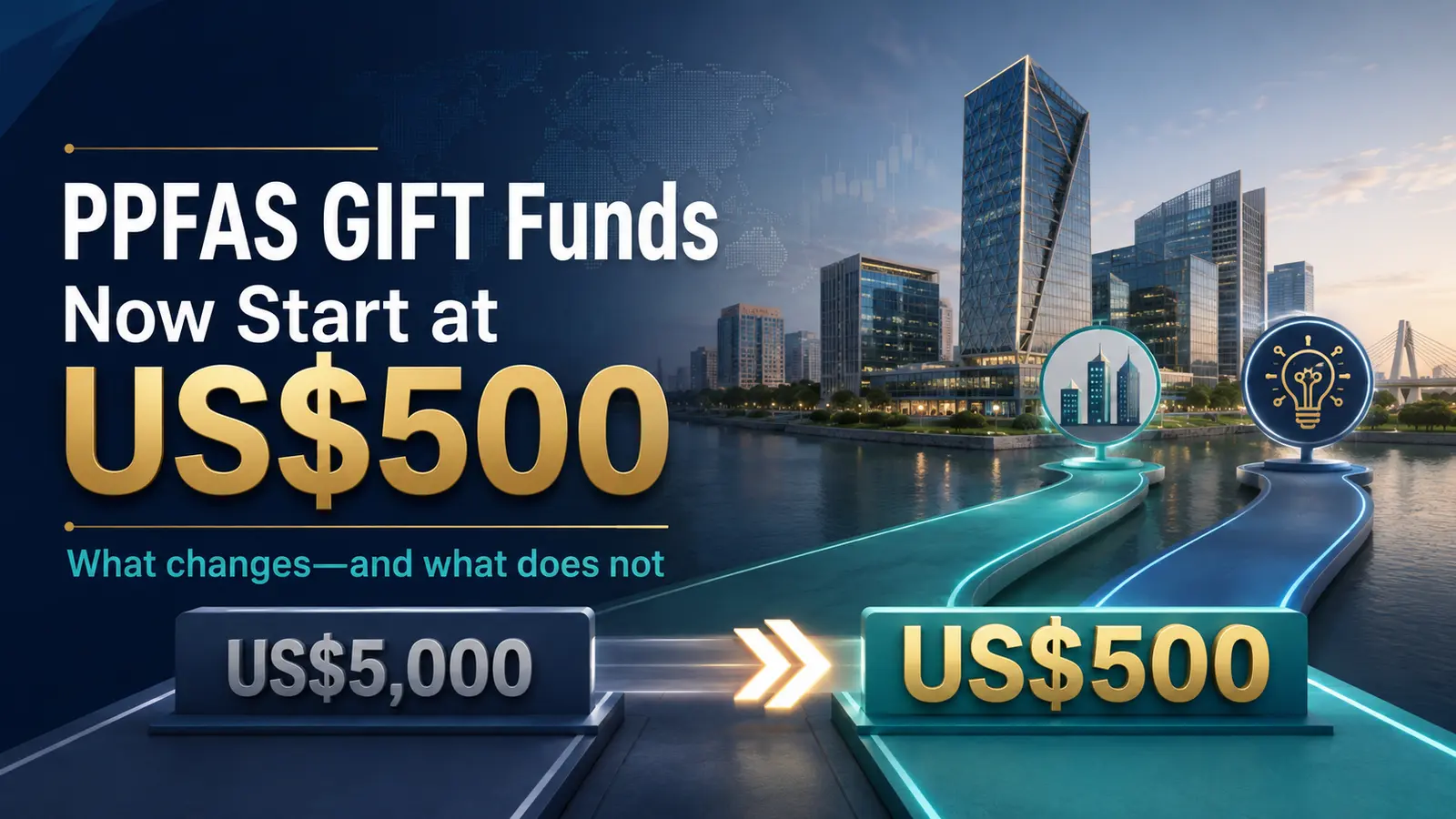
PPFAS Alternate Asset Managers IFSC Private Limited—commonly referred to as PPFAS GIFT—has reduced the minimum initial investment in two of its outbound passive funds from US5, 000toUS500. The revised amount applies to:
- Parag Parikh IFSC S&P 500 Fund of Fund
- Parag Parikh IFSC Nasdaq 100 Fund of Fund
The change became effective on 25 August 2026. It reduces the entry amount by 90%, allowing eligible investors to begin with one-tenth of the earlier commitment.
That is a meaningful improvement in accessibility. But the lower minimum does not make international investing automatically suitable, inexpensive or low-risk. Investors must still understand the funds, the remittance process, currency movement and how overseas equity fits within their overall portfolio.
What exactly has changed?
| Particular | Earlier | From 25 August 2026 | What it means |
|---|---|---|---|
| Minimum initial subscription | US$5,000 | US$500 | The entry requirement is 90% lower. |
| Minimum additional subscription | US$500 | US$500 | No change; subsequent additions continue from US$500. |
| Residual holding threshold after partial redemption | US$1,000 | US$100 | The fund may redeem the remaining units if their value falls below this revised threshold. |
The lower initial amount applies to both direct and distributor-routed classes, subject to the scheme documents and operational requirements.
What are these two funds?
Both are open-ended passive fund-of-fund schemes based in GIFT IFSC. They invest through accumulating exchange-traded funds and UCITS vehicles to provide exposure to their respective US equity indices. Their base currency is the US dollar.
| Feature | S&P 500 Fund of Fund | Nasdaq 100 Fund of Fund |
|---|---|---|
| Underlying exposure | 500 leading publicly traded US companies | 100 of the largest non-financial companies listed on Nasdaq |
| Benchmark | S&P 500 Net Total Return Index | Nasdaq 100 Notional Net Total Return Index |
| Portfolio character | Broader US large-company exposure across sectors | More concentrated exposure, with a strong tilt towards technology and innovation-led businesses |
| Minimum investment | US$500 | US$500 |
| Lock-in and exit load | No lock-in; no exit load under the current fund facts | No lock-in; no exit load under the current fund facts |
The S&P 500 and Nasdaq 100 are not interchangeable. The S&P 500 provides broader exposure to established US companies across multiple sectors. The Nasdaq 100 excludes financial companies and can be more concentrated in technology and growth-oriented businesses. That concentration may increase both return potential and volatility.
Why the lower minimum matters
The earlier US$5,000 requirement could translate into several lakh rupees, depending on the prevailing exchange rate and remittance costs. That was a large upfront commitment for an investor who wanted overseas equities to form only a modest part of the portfolio.
Reducing the minimum to US$500 helps in several ways.
1. Investors can start with a smaller allocation
International equity is usually one component of a diversified portfolio—not the entire portfolio. The lower minimum makes it easier to create a measured allocation without putting several lakh rupees into one product at the outset.
2. Portfolio rebalancing becomes more practical
Suppose an investor wants international equity to remain within a predetermined portfolio limit. A US5, 000entryamountcouldpushtheallocationabovethatlimit.AUS500 minimum provides finer control over how much is added.
3. The decision becomes less dependent on the entry ticket
Previously, an investor might have selected or rejected the GIFT City route primarily because of the minimum amount. The reduced threshold allows the decision to focus more appropriately on suitability, costs, diversification and risk.
4. It reduces—but does not remove—the operational cost concern
The investment may still involve bank remittance charges, foreign-exchange conversion spreads and other operational costs. These expenses can form a noticeable percentage of a US$500 remittance. Investors should compare the total amount debited in rupees with the amount that is actually invested.
How can a resident Indian invest?
The fund pages list resident Indian individuals among the eligible investors. A resident individual generally invests through the RBI’s Liberalised Remittance Scheme, or LRS.
Under LRS, resident individuals can remit up to US$250,000 per financial year for permitted current- and capital-account transactions, subject to the applicable rules and documentation. Investment remittances also count towards this overall limit.
The practical process may involve:
- Completing the fund’s KYC and onboarding requirements
- Selecting the appropriate scheme and unit class
- Providing the required LRS declaration and remittance details
- Sending money through an authorised dealer bank
- Receiving units according to the applicable subscription NAV and cut-off rules
Bank charges, exchange rates, Tax Collected at Source rules and documentation requirements can change. Check the current position with the bank, fund and tax adviser before remitting.
Is this the same as buying a domestic international mutual fund?
No. These are GIFT IFSC-based funds denominated in US dollars. A resident Indian generally remits money through LRS rather than investing in rupees like a conventional domestic mutual-fund purchase.
| Aspect | PPFAS GIFT outbound fund | Domestic international mutual fund |
|---|---|---|
| Investment currency | US dollars | Indian rupees |
| Resident-individual route | Generally through LRS | Normal domestic mutual-fund transaction |
| FX conversion | Investor remits in foreign currency and bears applicable conversion costs | Handled within the domestic fund structure |
| Operational effort | Additional remittance and compliance steps | Usually simpler for a resident retail investor |
| Availability | Subject to GIFT IFSC fund and onboarding rules | Subject to domestic overseas-investment limits and scheme availability |
Tax treatment and reporting can also differ. Do not assume that a GIFT City fund and a domestic international fund will produce identical post-tax outcomes merely because both track the same overseas index.
What has not changed?
The lower minimum changes accessibility—not the underlying investment risk.
US equity-market risk
Both schemes ultimately provide exposure to equities. Their value can fall significantly during market corrections, recessions or periods of weak corporate earnings.
Currency risk
The funds are denominated in US dollars, while most Indian investors measure goals in rupees. Movements between the rupee and the dollar can affect the rupee-equivalent outcome.
Concentration risk
The Nasdaq 100 can have substantial exposure to a relatively small group of large technology and growth companies. Even the broader S&P 500 is still a single-country, large-cap allocation.
Fund-of-fund and tracking costs
The investor bears costs at the fund level as well as expenses within the underlying ETF or UCITS vehicle. Tracking difference, cash holdings, taxes and operational expenses can cause returns to differ from the headline index.
Remittance and compliance requirements
The investment continues to involve LRS, foreign-exchange conversion, banking procedures and applicable tax or reporting requirements. A smaller investment amount does not remove these steps.
Who may find the revised minimum useful?
The lower threshold may be useful for an eligible investor who:
- Wants a limited allocation to US equities as part of a diversified portfolio
- Has a long investment horizon and can tolerate equity-market volatility
- Understands the differences between the S&P 500 and Nasdaq 100
- Is comfortable with LRS documentation and currency conversion
- Has already assessed domestic goals, emergency reserves and the overall asset allocation
It may not be suitable for money needed for an emergency fund, near-term goal or predictable payment. It is also not a reason to invest merely because US markets or technology stocks have recently performed well.
Five checks before investing US$500
- Check your target allocation. Decide how much international equity belongs in the complete portfolio before choosing the fund.
- Choose the index deliberately. Broader S&P 500 exposure and the more concentrated Nasdaq 100 serve different portfolio roles.
- Calculate the total remittance cost. Include the bank’s exchange rate, transfer fee, applicable taxes and the amount that will actually reach the fund.
- Understand the post-tax NAV structure. Read the offer document and current taxation guide instead of relying on a general statement about GIFT City taxation.
- Plan how you will review it. Monitor the international allocation as part of the total portfolio rather than judging the fund independently.
The bottom line
PPFAS GIFT’s reduction from US5, 000toUS500 is a meaningful improvement. It allows eligible investors to consider US equity exposure without committing several lakh rupees at the beginning and makes controlled portfolio allocation easier.
But a lower minimum is only an access change. It does not reduce US equity risk, Nasdaq concentration, currency movement, fund expenses or the operational work involved in remitting money through LRS.
The new US$500 entry point makes GIFT City investing more accessible. Your goal, portfolio allocation, time horizon and ability to handle international-equity risk should still decide whether you invest.
Frequently asked questions
Which PPFAS GIFT funds now accept US$500?
The revised minimum applies to the Parag Parikh IFSC S&P 500 Fund of Fund and the Parag Parikh IFSC Nasdaq 100 Fund of Fund.
Was the minimum additional investment also reduced?
The additional-subscription minimum was already US500andremainsUS500. The major change is that the first investment has fallen from US5, 000toUS500.
Is US$500 approximately a fixed amount in rupees?
No. The rupee amount changes with the exchange rate and the authorised dealer bank’s conversion rate. Remittance charges may increase the total amount debited from the investor’s account.
Does the lower minimum make the funds low-risk?
No. Both funds provide international equity exposure. The minimum ticket size affects accessibility, not market, currency or concentration risk.
Can a resident Indian invest without using LRS?
Resident individuals generally invest through LRS. Eligibility, permitted routes and documentation should be confirmed with the fund and authorised dealer bank for the investor’s specific case.
Official references
- PPFAS GIFT: S&P 500 Fund of Fund—fund facts and documents
- PPFAS GIFT: Nasdaq 100 Fund of Fund—fund facts and documents
- PPFAS GIFT: August 2026 notice-cum-addendum for the S&P 500 Fund of Fund
- RBI: Liberalised Remittance Scheme FAQs
Disclaimer
This article is for investor education only and does not constitute investment, legal or tax advice. International equity and mutual-fund investments are subject to market, currency, tracking and regulatory risks. Read the offer document, taxation guide and other scheme-related documents carefully. Rules, costs and tax treatment may change. Consult qualified investment and tax professionals before acting.