
Tag: SIP

  • Can India’s SIP Boom Prevent the Next Stock Market Crash?

    Can India’s SIP Boom Prevent the Next Stock Market Crash?

    India’s mutual fund SIP culture has grown enormously. Every month, thousands of crores flow into mutual funds through systematic investment plans.

    This has created a comforting belief:

    “Foreign investors may sell, but Indian mutual funds and SIP investors will keep buying. Therefore, the Indian market cannot fall 40% or 50% again.”

    Domestic investment undoubtedly makes the Indian market more resilient. But does it make a major crash impossible?

    The short answer is no.

    SIPs can cushion a market decline and help investors benefit from it. They cannot guarantee a floor below which share prices will not fall.

    How SIP money supports the market

    When investors continue their SIPs, mutual funds receive fresh money every month. Fund managers can use this money to buy shares, including when foreign investors are selling.

    Domestic institutions have repeatedly absorbed substantial foreign selling in recent years. This can:

    • Reduce the immediate impact of foreign outflows
    • Provide liquidity when markets decline
    • Make some ordinary corrections less severe
    • Help markets recover when investor confidence returns

    However, SIP money is only one source of market demand.

    Domestic institutional investor—or DII—figures also include investments by insurers and other institutions. Moreover, not every SIP rupee enters equity, and mutual funds need not invest all the money immediately.

    Therefore, rising SIP collections do not automatically translate into an equal amount of stock-market buying every day.

    Market support is not a guaranteed price floor

    A market does not fall merely because there are no buyers. It falls when buyers are willing to buy only at lower prices.

    Imagine that investors want to sell shares worth ₹1,000 crore. Domestic mutual funds may be willing to buy the entire quantity—but only after prices decline by 10%.

    The presence of buyers has provided liquidity, but it has not prevented the fall.

    Now imagine a more serious situation involving:

    • A banking or credit crisis
    • Excessive corporate leverage
    • A sharp fall in company earnings
    • A global financial crisis
    • War or an unexpected geopolitical event
    • Forced selling by leveraged investors
    • A loss of confidence among domestic investors themselves

    Monthly SIP inflows may not be large enough to offset all these forces simultaneously.

    A correction and a systemic crash are different

    An ordinary correction may occur because valuations have become expensive, foreign investors are selling or traders are booking profits. Regular domestic inflows can soften such corrections.

    A systemic crash is different. It involves a widespread reassessment of earnings, risk and asset values. Sometimes investors or institutions are also forced to sell because they need money or have borrowed against their investments.

    India’s earlier major market falls followed very different triggers:

    • The 1992 securities-market scam
    • The technology and Ketan Parekh collapse of 2000–01
    • The global financial crisis of 2008
    • The sudden COVID-19 shock of 2020

    SIP investments cannot prevent an unknown future event from affecting company values and investor confidence.

    What if SIP investors themselves become worried?

    Regular investing often remains strong during short corrections. Investors are comfortable “buying the dip” when they expect markets to recover quickly.

    The real behavioural test comes when:

    • Markets remain weak for one or two years
    • Investors see substantial losses in their portfolios
    • Job or business income becomes uncertain
    • News remains consistently negative
    • Previous market highs appear far away

    Some investors may stop their SIPs or redeem existing investments precisely when markets need domestic buying support.

    This is why SIPs should be treated as an investment discipline, not as a permanent guarantee that every investor will continue regardless of circumstances.

    Reports about the SIP stoppage ratio must also be interpreted carefully. The discontinued count can include SIPs that completed their tenure, ceased after failed instalments or were affected by data-cleaning exercises. A stoppage ratio above 100% does not necessarily mean widespread investor panic.

    What SIPs actually protect you from

    A SIP does not protect your portfolio from market losses. Its real benefit is different.

    It protects you from having to correctly predict the best day to invest.

    When markets fall:

    • Your existing investments may decline in value
    • Your subsequent SIP instalments purchase more units
    • Your average purchase cost may reduce
    • You participate automatically when the recovery begins

    Suppose an investor already has ₹10 lakh in equity funds and contributes ₹20,000 every month. If the market falls sharply, the monthly ₹20,000 SIP cannot prevent the existing ₹10 lakh portfolio from declining.

    However, continuing that SIP allows the investor to accumulate additional units at lower prices.

    That is the real power of SIP investing.

    High valuations still matter

    Strong domestic flows can sometimes support expensive valuations for longer. But they cannot permanently replace business earnings.

    If investors pay very high prices relative to company profits, future returns may become more dependent on:

    • Continued earnings growth
    • Continued investor inflows
    • Stable interest rates
    • Sustained market confidence

    When expectations change, valuations can fall even if SIP contributions remain healthy.

    Valuation alone does not cause every crash, but a highly valued market generally has less room for disappointment.

    How investors should prepare

    Continue goal-linked SIPs

    Do not stop long-term SIPs merely because markets have corrected. Lower prices are precisely when future instalments accumulate more units.

    Keep near-term goals away from equity

    Money required within the next three to five years should not depend entirely on an equity-market recovery.

    Maintain an emergency fund

    An emergency reserve helps prevent forced redemption during a market decline or income disruption.

    Control mid-cap and small-cap exposure

    These segments can fall considerably more than broad-market large-cap indices. Allocate based on your ability to tolerate the decline—not only your expected return.

    Rebalance instead of predicting

    When equity falls below its planned allocation, rebalancing from debt to equity can convert a correction into an opportunity without requiring an accurate market forecast.

    Test your real risk capacity

    Do not ask only, “Am I an aggressive investor?”

    “If my equity portfolio falls 40% and remains below its previous high for two years, will I continue investing?”

    The answer provides a much better indication of your true risk capacity.

    The final takeaway

    India’s growing SIP culture is a positive structural development. It reduces dependence on foreign investors and may soften many ordinary corrections.

    But SIPs cannot repeal market cycles.

    They cannot prevent earnings declines, credit crises, excessive valuations, leverage or investor panic. Their greatest strength is not that they stop markets from falling—it is that they help disciplined investors continue buying through the fall.

    Keep your SIP running, but do not mistake it for a market guarantee.

    This article is intended for investor education and does not constitute personalised investment advice.

  • Month-End Financial Checkup: 7 Things Every Family Should Review

    Month-End Financial Checkup: 7 Things Every Family Should Review

    Most families do not need to examine every bank transaction or
    rebuild their entire financial plan each month. But allowing several
    months to pass without a review can make small problems harder to
    notice.

    A subscription may continue even though it is no longer used. A large
    annual payment may arrive without enough money set aside. SIPs may fail
    because of a low bank balance. Credit-card spending may rise gradually.
    Investments may continue, but without a clear connection to the family’s
    goals.

    A simple monthly financial checkup can catch these
    issues early.

    The purpose is not to judge every purchase or make family finances
    feel restrictive. It is to understand what happened during the month,
    prepare for what is coming next and decide whether one small correction
    is needed.

    Set aside about 20 minutes near the end of every month. Keep your
    bank accounts, credit cards, loan information and investment records
    available, and work through the following seven checks.

    1. Compare the month’s
    income and spending

    Begin with the most basic question:

    Did more money come in than go out this month?

    List the household’s income received during the month. Depending on
    the family, this may include salary, professional or business income,
    pension, rent, interest or other regular receipts.

    Then review the total amount spent. You do not need to classify every
    small purchase perfectly. Start with broad groups such as:

    • Housing and utilities
    • Groceries and household needs
    • School and childcare
    • Healthcare
    • Transport
    • Insurance
    • EMIs and other debt payments
    • Investments
    • Lifestyle and discretionary spending

    If spending exceeded income, do not immediately assume that the month
    was financially poor. A planned insurance premium, school fee or home
    repair can create a temporary deficit. The important distinction is
    whether the excess spending was planned and funded or
    had to be met through new debt.

    When spending exceeds income repeatedly, however, the household may
    be depending on bonuses, credit cards or withdrawals from savings to
    maintain its lifestyle. That pattern deserves attention.

    2. Identify one
    unusual or avoidable expense

    Monthly reviews often fail because people try to examine and correct
    everything at once. A more sustainable approach is to identify just one
    item that deserves attention.

    Look for:

    • A subscription that is no longer used
    • Repeated food-delivery or convenience spending
    • Credit-card interest or late-payment fees
    • A utility bill that is unusually high
    • Multiple small instalments that have accumulated
    • An impulse purchase that disrupted the monthly plan

    Not every discretionary expense is wasteful. Money is also meant to
    support comfort, enjoyment and family experiences. The question is
    whether the spending was intentional and whether it displaced something
    more important.

    Choose one realistic improvement for next month. For example, cancel
    an unused subscription, set a dining-out limit or move a recurring bill
    to a date when the bank balance is normally stronger.

    Small corrections repeated every month are usually easier to maintain
    than a severe budget imposed once and abandoned quickly.

    3. Prepare for next
    month’s large payments

    A monthly review should look forward as well as backward.

    Check the calendar for expenses expected during the next four to
    eight weeks, including:

    • School or college fees
    • Insurance premiums
    • Property tax or maintenance charges
    • Festivals, travel or family functions
    • Vehicle service and repairs
    • Medical appointments
    • Annual subscriptions
    • Tax instalments or professional expenses

    These are not true emergencies merely because they do not occur every
    month. If an expense is predictable, it should gradually be included in
    the financial plan.

    Suppose a ₹24,000 insurance premium is due once a year. Setting aside
    ₹2,000 each month can make the payment far easier to manage than finding
    the full amount at the last moment.

    This method is sometimes called a sinking fund: money is accumulated
    gradually for a known future expense. It can be maintained in a suitable
    bank account or other appropriate low-risk avenue based on when the
    money will be required.

    4. Review your EMI
    and credit-card position

    Paying every EMI on time is essential, but it does not automatically
    mean the household’s debt is comfortable.

    During the monthly financial checkup, confirm:

    • All EMIs and credit-card bills were paid by the due date
    • Credit-card bills were paid in full wherever possible
    • No new loan or instalment was added without considering the total
      commitment
    • Loan rates, EMI amounts or tenures have not changed
      unexpectedly
    • Enough income remains after repayments for expenses, emergency
      savings and goals

    A family should be particularly cautious when small consumer EMIs
    begin to multiply. Each instalment may look affordable independently,
    while their combined effect can reduce financial flexibility.

    Also calculate your EMI-to-income ratio periodically:

    EMI-to-income ratio = Total monthly EMIs ÷ Monthly take-home
    income × 100

    This ratio is only an indicator. Income stability, dependants,
    emergency savings, loan cost and the amount remaining after essential
    expenses are equally important.

    For a detailed debt review, read: Debt
    Fitness: How Much of Your Monthly Income Should Go Towards EMIs?

    5. Confirm that
    savings and investments happened

    Many people review only spending and forget to check whether the
    month’s saving and investment plan was completed.

    Verify that:

    • SIPs were successfully processed
    • Recurring deposits or other planned savings were credited
    • Retirement contributions were made as intended
    • Failed transactions were noticed and addressed
    • Adequate balance is available for SIPs due early next month

    Do not judge the month by whether the market value of your
    investments rose or fell. Market-linked investments will fluctuate. A
    monthly review is better used to check whether your actions remain
    consistent with your plan.

    If a SIP failed, first identify the reason. It may be a temporary
    bank-balance issue, an expired mandate or a technical problem. One
    failed transaction does not require changing the investment itself, but
    repeated failures can delay the goal.

    If income has increased, the review can also prompt a useful
    question: should part of the increase be directed towards goals before
    lifestyle expenses expand to absorb it?

    6. Check your
    emergency-fund balance

    An emergency fund protects the family from having to sell long-term
    investments or take expensive debt when income is interrupted or an
    urgent expense arises.

    At the end of the month, check whether the emergency reserve was:

    • Used for a genuine emergency
    • Used for a predictable expense that should have been planned
      separately
    • Replenished after an earlier withdrawal
    • Kept accessible rather than exposed to unnecessary market risk

    The appropriate emergency-fund amount differs between families. A
    household with two stable salaries may need a different buffer from a
    single-income family, retiree, freelancer or business owner with
    variable cash flow. Dependants, medical needs, insurance coverage and
    job stability also matter.

    The monthly check does not require recalculating the entire target
    every time. Simply confirm that the reserve is intact and that any
    withdrawal has a replenishment plan.

    It also helps to keep the emergency fund separate from money reserved
    for travel, school fees, home renovation or other known expenses. Mixing
    them can create the impression that more emergency money is available
    than actually exists.

    7. Review progress
    towards one important goal

    Families may have several financial goals: retirement, children’s
    education, a home purchase, travel, vehicle replacement or care for
    parents. Reviewing every goal in detail each month is unnecessary.

    Instead, select one important goal and ask:

    • Is the target amount or expected cost still reasonable?
    • Is the time available unchanged?
    • Did the planned investment happen this month?
    • Has a change in income or family circumstances affected the
      goal?
    • Is the money invested in a way that suits the goal’s timeline and
      risk?

    Avoid reacting to one month of market movement. Goal planning is
    about whether the required amount is likely to be available when needed,
    not whether the portfolio delivered a positive return every month.

    A detailed goal review may be required annually or after a major life
    event such as marriage, childbirth, a job change, inheritance,
    retirement or a large new loan. The monthly checkup simply keeps the
    goal visible between those deeper reviews.

    A simple 20-minute monthly
    review

    You can divide the review as follows:

    Time What to review
    5 minutes Income, total spending and bank balances
    3 minutes Unusual expenses and subscriptions
    3 minutes Upcoming bills and annual payments
    3 minutes EMIs and credit-card dues
    3 minutes SIPs, savings and failed transactions
    2 minutes Emergency-fund balance
    1 minute Choose one action for next month

    The review does not need to produce a perfect spreadsheet. A
    notebook, a simple worksheet or a secure financial-planning application
    can be enough if the information is kept consistently.

    Your month-end checklist

    Before closing the review, confirm the following:

    What should the one action
    be?

    The most valuable outcome of a monthly financial checkup is not a
    score. It is one clear next step.

    Depending on what the review reveals, the action might be:

    • Cancel an unused subscription
    • Set aside money for an annual premium
    • Clear a small high-cost loan
    • Restore money used from the emergency fund
    • Correct a failed SIP mandate
    • Increase a goal investment after an income rise
    • Discuss a major upcoming expense with the family

    Keep the action specific and achievable before the next review.
    Trying to change the budget, investments, loans, insurance and goals
    simultaneously can make the process difficult to sustain.

    The takeaway

    Financial planning is not a once-in-a-lifetime exercise. It works
    best as a series of small, regular decisions.

    A 20-minute monthly financial checkup can help your family understand
    its cash flow, prepare for known expenses, prevent debt from quietly
    expanding and ensure that savings and investments actually happen. It
    can also make financial discussions calmer because decisions are based
    on visible information rather than last-minute pressure.

    You do not need to make a major change every month. If the review
    confirms that spending is manageable, payments are prepared for,
    investments are continuing and goals remain on track, that itself is
    useful clarity.

    Review the month. Choose one improvement. Then move forward.


    Frequently Asked Questions

    Do I need a
    detailed budget for this monthly review?

    No. A detailed budget can be useful, but the checkup can begin with
    total income, broad spending categories, upcoming payments, debt and
    investments. Add more detail only where it helps you make a
    decision.

    Should every family
    member participate?

    At least the adults responsible for earning, spending, borrowing and
    investing should understand the household’s position. The discussion can
    be kept brief and should focus on shared decisions rather than blaming
    an individual for particular expenses.

    What if my income changes
    every month?

    Use a conservative estimate of sustainable income and maintain a
    larger buffer for low-income months. Review cash flow more frequently
    when income is highly variable.

    Should I check
    investment returns every month?

    You may review the account for failed transactions or unusual
    activity, but reacting to short-term returns can lead to poor decisions.
    Evaluate market-linked investments according to the goal, time horizon
    and appropriate longer-term review process.

    Is
    the monthly review enough for complete financial planning?

    No. Insurance needs, retirement planning, asset allocation,
    nominations, taxes and estate or succession matters require deeper
    periodic reviews. The monthly checkup supports those plans; it does not
    replace them.


    Disclaimer

    This article is for educational purposes only and does not constitute
    investment, tax, legal, insurance or lending advice. Financial decisions
    should consider the family’s income stability, expenses, dependants,
    liabilities, insurance, goals, time horizon and risk profile. Consult an
    appropriate professional when required.


  • Small-Cap SIP Assets Have Grown 5x: Should You Increase Yours?

    Small-Cap SIP Assets Have Grown 5x: Should You Increase Yours?

    Small-cap mutual funds have attracted significant SIP money over the
    past five years.

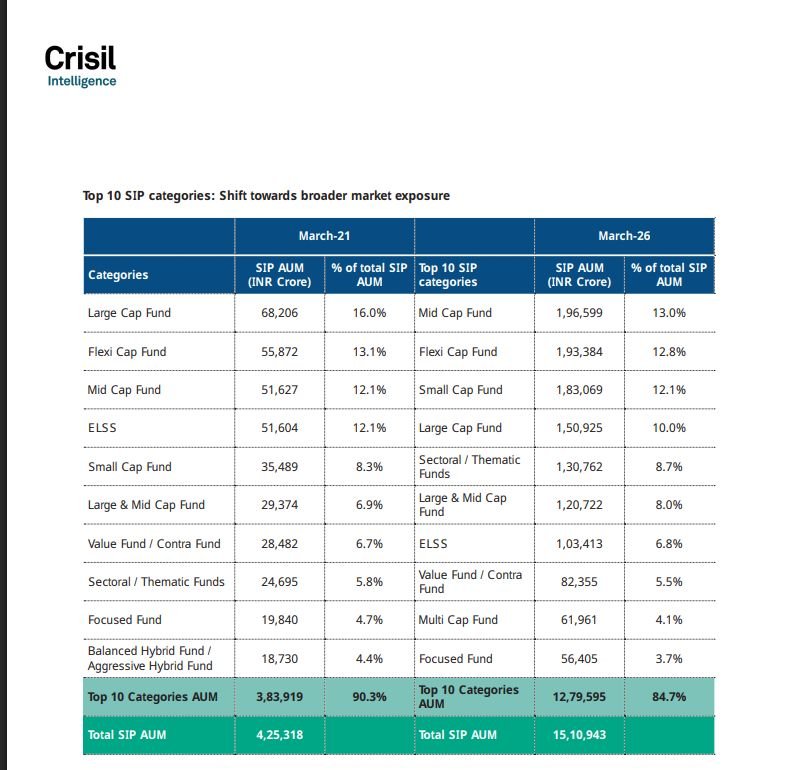
    According to the AMFI–Crisil Factbook 2026, SIP
    assets in small-cap funds increased from ₹35,489 crore in March
    2021 to ₹1,83,069 crore in March 2026
    . That is an increase of
    approximately 5.2 times in five years.

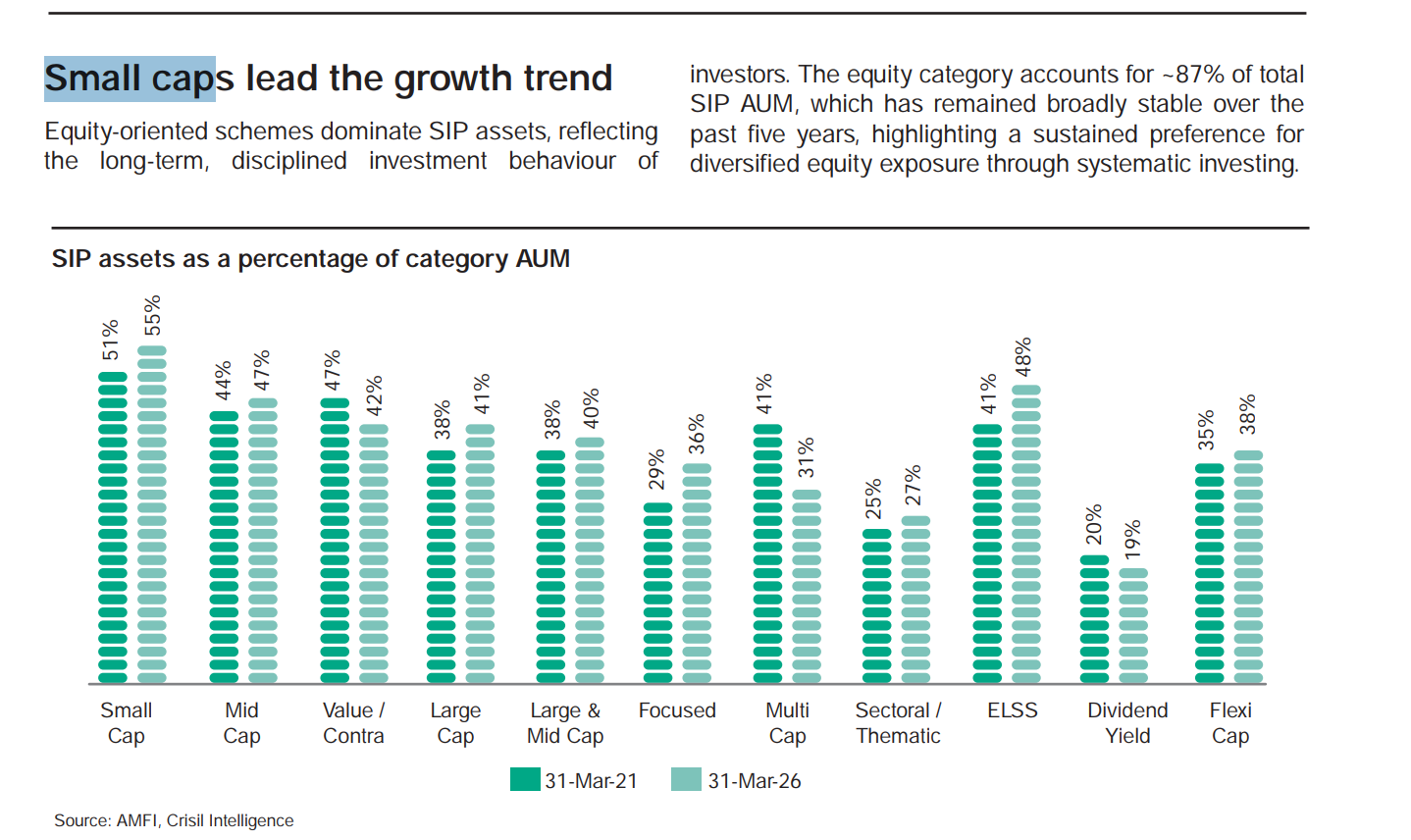
    The report also states that SIP assets represented 55% of the
    total assets in the small-cap fund category
    as of March
    2026—the highest proportion among the equity-fund categories shown in
    the report.

    These figures demonstrate how strongly investors have embraced
    small-cap SIPs. But do they also mean that you should increase
    yours?

    Not necessarily.

    The growth of an investment category tells us where investors have
    been putting their money. It does not tell us whether that category is
    attractively valued today, whether it will outperform next, or whether
    it is suitable for a particular investor.

    What Does the 55% Figure
    Actually Mean?

    The 55% figure can easily be misunderstood.

    It does not mean that small-cap funds received 55%
    of all SIP investments in India. It also does not represent a return
    earned by investors.

    It means that, as of March 2026, the value of assets accumulated
    through SIPs in small-cap schemes accounted for approximately
    55% of the total AUM of the small-cap fund
    category
    .

    The same chart shows that this proportion was 51% in March 2021. The
    increase from 51% to 55% is meaningful, but the much larger change is
    visible in the absolute SIP assets accumulated in the category.

    The factbook’s category table shows:

    Small-cap SIP data March 2021 March 2026
    SIP AUM ₹35,489 crore ₹1,83,069 crore
    Share of total industry SIP AUM 8.3% 12.1%

    Therefore, the accurate conclusion is:

    Small-cap SIP assets grew by approximately 5.2
    times—not necessarily the total AUM of small-cap funds and certainly not
    investor returns.

    AMFI-Crisil table showing small-cap SIP AUM increasing from ₹35,489 crore in March 2021 to ₹1,83,069 crore in March 2026.
    Leading mutual-fund categories by SIP AUM in March 2021 and March 2026. Source: AMFI-Crisil Factbook 2026.

    Why Have Small-Cap
    SIP Assets Grown So Much?

    The increase is likely the result of several forces acting
    together:

    • More investors have entered mutual funds through monthly SIPs.
    • Strong historical periods for smaller companies attracted investor
      attention.
    • Investment platforms have made starting and managing SIPs
      easier.
    • Small monthly investments can make a volatile category feel more
      approachable.
    • Investors increasingly associate small-cap companies with higher
      long-term growth potential.

    However, a category often becomes most popular after
    it has delivered attractive returns. This can encourage investors to
    increase exposure based on recent performance rather than their
    financial plan.

    That is why rising SIP participation should be treated as a trend to
    understand—not as a buy signal.

    A SIP
    Changes How You Invest, Not What You Invest In

    A SIP spreads investments across different market levels instead of
    committing the entire amount on one day. This can reduce the risk of
    investing a large lump sum at an unfavourable time and helps build
    investing discipline.

    But a SIP does not remove the underlying risk of the asset.

    If small-cap stocks decline sharply, a small-cap fund can also
    experience a substantial fall. Continuing the SIP during that period may
    allow the investor to accumulate more units at lower NAVs, but the
    portfolio value can still remain below the invested amount for an
    extended period.

    A SIP therefore does not:

    • guarantee positive returns;
    • prevent short-term or medium-term losses;
    • make every fund suitable for every investor;
    • compensate for an excessive small-cap allocation; or
    • turn a short investment horizon into a long one.

    The discipline of a SIP is valuable only when the investor can remain
    invested through the category’s difficult periods.

    Why Small-Cap Funds Need
    More Patience

    Under the mutual-fund categorisation framework, small-cap companies
    are generally those ranked 251st onwards by full market
    capitalisation
    . A small-cap fund is required to invest at least
    65% of its assets in small-cap stocks.

    Compared with established large companies, smaller companies may
    have:

    • less diversified businesses;
    • lower trading liquidity;
    • greater dependence on a few customers or products;
    • more sensitivity to economic slowdowns;
    • limited ability to raise capital during difficult periods; and
    • wider differences between successful and unsuccessful
      businesses.

    This does not make small-cap funds unsuitable. It means that the
    potential for higher growth comes with greater uncertainty, deeper
    volatility and the possibility of prolonged underperformance.

    An investor who needs the money in three or five years may not have
    enough time to wait for the category to recover from an unfavourable
    market cycle. Small-cap exposure is generally more appropriate for goals
    that are at least seven to ten years away, with the
    understanding that even a long horizon does not guarantee a particular
    return.

    Should You Increase Your
    Small-Cap SIP?

    The answer should depend on your allocation—not on the industry’s
    growth statistics.

    Consider increasing it only
    when:

    • your financial goal is sufficiently long-term;
    • your emergency fund and near-term requirements are already
      covered;
    • small caps currently form less than your planned allocation;
    • you understand the small-cap exposure already present in your
      flexicap, multicap or other equity funds;
    • you can continue investing through a sharp decline; and
    • the increase is part of a portfolio plan rather than a response to
      recent returns.

    Maintain the existing SIP
    when:

    • the current allocation is already close to your target;
    • the SIP amount remains appropriate for the goal;
    • your risk capacity and time horizon have not changed; and
    • recent category popularity is the only reason you are considering an
      increase.

    Consider reducing or
    redirecting it when:

    • small caps have become an excessive part of your equity
      portfolio;
    • you hold several small-cap funds with substantial portfolio
      overlap;
    • an important goal is getting closer;
    • market falls are causing you to stop or frequently change SIPs;
      or
    • you selected the category mainly because it had recently delivered
      high returns.

    Measure
    Small-Cap Exposure Across the Entire Portfolio

    Looking only at the fund named “Small Cap” can understate your actual
    exposure.

    Flexicap, multicap, focused, value and some thematic funds may also
    hold small-cap stocks. If you own several such schemes, your total
    small-cap exposure can be higher than expected.

    For example, suppose equity represents 70% of your overall investment
    portfolio and you decide that small caps should represent 15% of the
    equity portion.

    Your small-cap allocation at the total-portfolio level would be:

    70% × 15% = 10.5% of the overall portfolio

    The correct comparison is between this target and your combined
    small-cap exposure across every fund—not merely the value of your
    dedicated small-cap scheme.

    A Practical Way to
    Manage the Allocation

    Instead of changing the SIP based on headlines, use a simple
    process:

    1. Identify the goal: Confirm when the money will be
      required.
    2. Calculate existing exposure: Include small-cap
      holdings inside all equity schemes.
    3. Set a target range: Use a range rather than
      expecting the allocation to remain at one exact percentage.
    4. Direct new SIPs thoughtfully: Add money to an
      underweight category instead of automatically choosing the recent
      winner.
    5. Review periodically: Review annually or when the
      allocation moves materially outside its target—not every time markets
      fluctuate.

    This approach turns the decision from “Are small-cap funds doing
    well?” into the more useful question: “Does my current allocation still
    suit my goal and my ability to handle risk?”

    The Takeaway

    The rise of small-cap SIP assets from ₹35,489 crore to ₹1,83,069
    crore is a significant change in Indian investor behaviour. It shows
    that SIPs have become an important route for participating in small-cap
    funds.

    But popularity is not the same as suitability.

    A small-cap SIP can play a useful role in a diversified, long-term
    portfolio. Whether you should start, increase or maintain one depends on
    your goal, investment horizon, existing exposure and ability to remain
    invested through severe volatility.

    The AMFI–Crisil data gives us a reason to examine our allocation. It
    does not give everyone a reason to increase it.


    Sources

    This article is for educational purposes only and should not be
    treated as investment advice or a recommendation to invest in any
    particular mutual-fund scheme. Mutual-fund investments are subject to
    market risks. Read all scheme-related documents carefully and consider
    consulting a qualified financial professional before investing.