
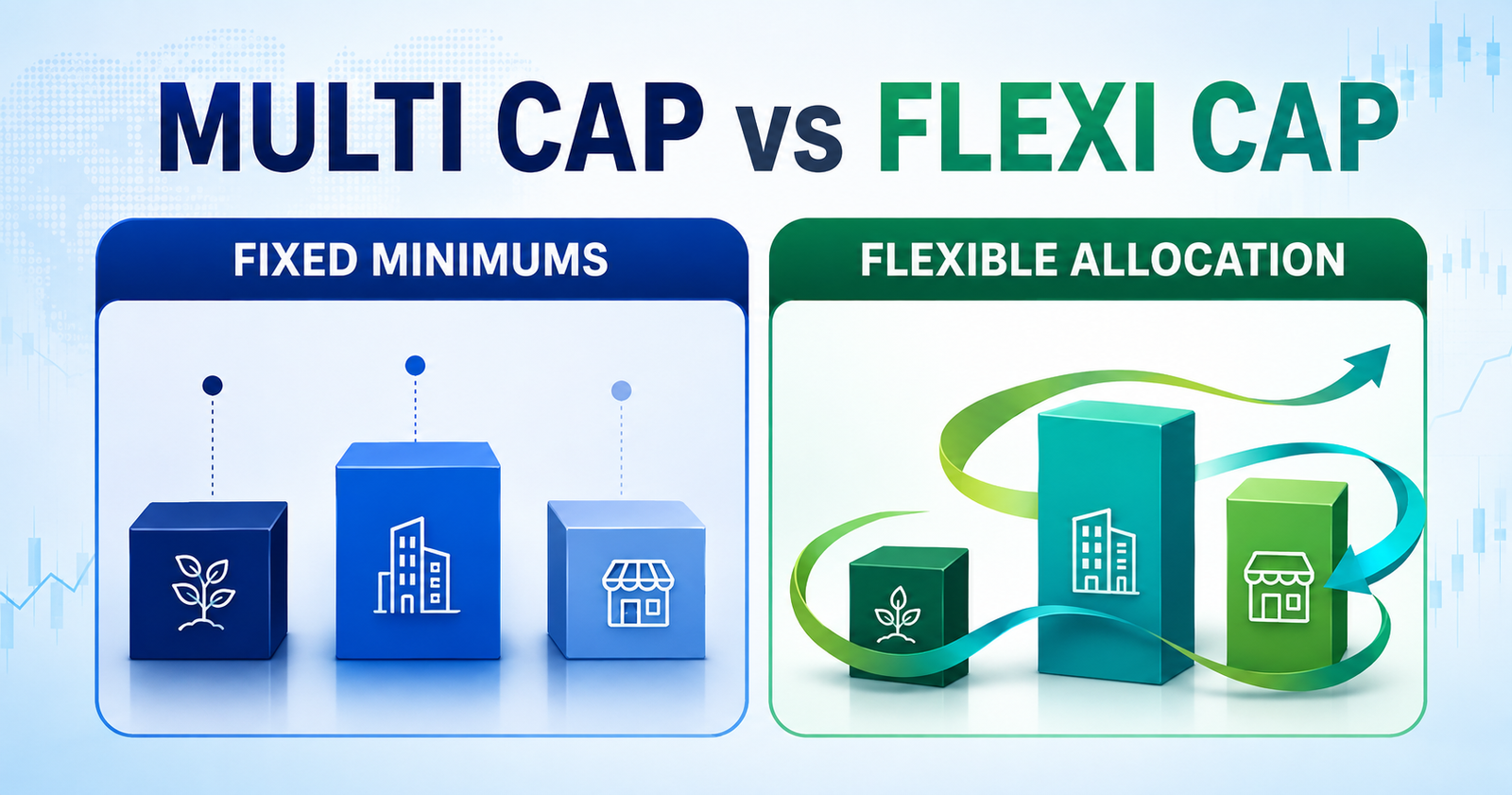
Multi Cap and Flexi Cap funds can both invest in large-cap, mid-cap and small-cap stocks.
So why do we need two separate categories?
The key difference is simple:
Multi Cap funds follow fixed minimum allocation rules. Flexi Cap funds give the fund manager more freedom to decide how much to invest in each market-cap segment.
That difference can significantly affect how the fund behaves in different market conditions.
Multi Cap vs Flexi Cap: Quick Comparison
| Feature | Multi Cap Fund | Flexi Cap Fund |
|---|---|---|
| Large-cap exposure | Minimum 25% | No fixed minimum |
| Mid-cap exposure | Minimum 25% | No fixed minimum |
| Small-cap exposure | Minimum 25% | No fixed minimum |
| Fund manager flexibility | Lower | Higher |
| Meaningful mid/small-cap exposure | Built into the category | Depends on fund manager |
| Can become heavily large-cap oriented | No | Yes |
| Risk level | Usually higher due to mandatory mid/small-cap exposure | Depends on actual portfolio |
The easiest way to remember it is:
Multi Cap = Allocation
Flexi Cap = Flexibility
What Is a Multi Cap Fund?
A Multi Cap Fund must invest at least:
- 25% in large-cap stocks
- 25% in mid-cap stocks
- 25% in small-cap stocks
This means the fund always has meaningful exposure across all three market-cap segments.
That can be useful for investors who want one fund that gives them exposure to the broader equity market.
But there is an important trade-off.
Even if mid-cap or small-cap valuations become expensive, the fund manager cannot completely move away from those segments.
So a Multi Cap fund may experience higher volatility when mid- and small-cap stocks fall sharply.
What Is a Flexi Cap Fund?
A Flexi Cap Fund can also invest across large-, mid- and small-cap companies.
The difference is that there is no fixed minimum allocation to each market-cap segment.
The fund manager can decide where the best opportunities are.
For example, a Flexi Cap fund could hold:
- 75% Large Cap
- 15% Mid Cap
- 10% Small Cap
At another point, the same fund could move to:
- 50% Large Cap
- 30% Mid Cap
- 20% Small Cap
This gives the manager more flexibility to respond to valuations and market conditions.
A Simple Example
Suppose mid-cap and small-cap stocks have gone through a strong rally and now look expensive.
A Flexi Cap manager may decide to reduce exposure to those segments and increase large-cap allocation.
A Multi Cap manager cannot do the same beyond a point because the fund must continue to maintain at least 25% in both mid- and small-cap stocks.
This is the core difference between the two categories.
A Multi Cap fund guarantees diversification across market caps. A Flexi Cap fund gives the manager freedom to decide the diversification.
Is Flexi Cap Better?
Not necessarily.
Flexibility can be useful, but it also means the fund manager’s decisions matter more.
If the manager reduces mid- and small-cap exposure before those segments rally strongly, the fund may underperform a Multi Cap fund.
Likewise, if the manager correctly avoids an expensive market segment before a fall, that flexibility may help.
So Flexi Cap is not automatically safer or better.
Its behaviour depends on the actual portfolio.
Is Multi Cap Better?
Again, not necessarily.
Multi Cap works well for investors who specifically want meaningful exposure to large-, mid- and small-cap companies.
The advantage is that the fund cannot quietly become almost entirely large-cap.
The disadvantage is that the fund cannot substantially reduce mid- or small-cap exposure during difficult market conditions.
So Multi Cap is better viewed as a structured all-market allocation, rather than simply a more aggressive version of Flexi Cap.
Who May Prefer a Multi Cap Fund?
A Multi Cap fund may suit you if you:
- Want meaningful exposure to large, mid and small companies
- Prefer market-cap diversification to be built into the fund
- Have a long investment horizon
- Are comfortable with higher equity volatility
- Do not want allocation decisions to depend entirely on the fund manager
Who May Prefer a Flexi Cap Fund?
A Flexi Cap fund may suit you if you:
- Prefer the fund manager to have greater flexibility
- Want one diversified equity fund without fixed market-cap weights
- Already have separate mid-cap or small-cap funds
- Want the manager to reduce exposure to unattractive market segments when necessary
Can You Invest in Both?
Yes, but that does not automatically improve diversification.
For example, if you already hold:
- A Flexi Cap fund
- A Mid Cap fund
- A Small Cap fund
adding a Multi Cap fund may further increase your mid- and small-cap exposure.
The better question is not:
“Can I invest in both?”
It is:
“What role does each fund play in my overall portfolio?”
Always look at your total asset allocation rather than choosing mutual funds one category at a time.
Don’t Choose Based Only on Recent Returns
A Multi Cap fund may outperform during a strong mid- and small-cap rally simply because it is required to maintain meaningful exposure to those segments.
A Flexi Cap fund with a large-cap-heavy portfolio may lag during the same period.
That does not necessarily mean one fund is better than the other.
Before comparing funds, look at:
- Portfolio allocation
- Risk taken
- Rolling returns
- Drawdowns
- Consistency
- Investment style
- Role in your overall portfolio
Returns make more sense when viewed together with the risk taken to generate them.
Final Takeaway
Multi Cap and Flexi Cap funds invest across the same broad market-cap universe, but their portfolio construction is different.
Multi Cap
- Minimum 25% Large Cap
- Minimum 25% Mid Cap
- Minimum 25% Small Cap
Best understood as a fund with built-in market-cap diversification.
Flexi Cap
No fixed allocation between large, mid and small caps
Best understood as a fund that gives the manager greater allocation flexibility.
Neither category is automatically better.
The right choice depends on your:
- Existing portfolio
- Risk tolerance
- Investment horizon
- Need for mid- and small-cap exposure
- Preference for structured allocation versus fund-manager flexibility
The most important thing is to understand what role the fund is expected to play in your overall portfolio.
Frequently Asked Questions
Is Multi Cap riskier than Flexi Cap?
Multi Cap funds have mandatory exposure to mid- and small-cap stocks, which can make them more volatile. Flexi Cap risk depends on how the fund manager actually allocates the portfolio.
Can a Flexi Cap fund invest mostly in large caps?
Yes. A Flexi Cap fund does not have a fixed minimum allocation to mid- or small-cap stocks.
Can a Multi Cap fund reduce small-cap exposure when valuations are high?
It can reduce exposure only up to the regulatory minimum. It must continue to maintain at least 25% in small-cap stocks.
Should I hold both Multi Cap and Flexi Cap funds?
You can, but first check whether doing so creates unnecessary overlap or excessive mid- and small-cap exposure.
Disclaimer
This article is for educational purposes only and should not be considered investment advice or a recommendation to invest in any particular mutual fund or category. Mutual fund investments are subject to market risks. Consider your financial goals, investment horizon and risk profile before investing.
Leave a Reply